Powder Coating Stainless Steel: What It Takes to Make Powder Stick
This article is general information only. Prep, media, primer, and warranty details for your parts are confirmed at the estimate.
Stainless is the metal people assume needs no help. A railing section or a set of fabricated brackets shows up bright, smooth, and spotless, and the first thing anyone wants to know at the counter is whether powder will even stick to something that slick. It is a fair question, because powder coating stainless steel is a prep job before it is a color job. The same self-protecting surface that keeps stainless from rusting is what makes adhesion the hard part, and corrosion resistance is not the same as coating readiness.
Can You Powder Coat Stainless Steel?
Yes. Stainless steel can be powder coated when it is clean, blasted to a profile, and prepped for adhesion. The powder is applied and cured much as it is on mild steel. The difference is in the prep, and skipping it is a likely reason stainless jobs fail.
One caveat up front: some stainless parts are better left bare. We cover which ones further down.
Powder Coating Stainless Steel: Why the Surface Needs More Than a Wipe-Down
The passive surface problem
Stainless steel protects itself. The chromium in the alloy reacts with oxygen in the air to form a thin, invisible, self-healing oxide film, often called a passive layer, that guards the metal against corrosion. That is why a stainless bracket left out through a Utah winter can still look bright in spring.
The catch is that a smooth passive surface gives powder very little to hold onto. Mild steel is a different story, because common pretreatments such as zinc phosphate are designed to react with it. As Products Finishing explains in "Preparing for Stainless Steel", a zinc phosphate and chrome sealer line will not react with 304 stainless, so those stages provide no direct benefit on it. The same answer suggests scuff sanding for "tooth" or a silane adhesion promoter when a surface lacks enough roughness, and it advises testing adhesion first.
If you want the chemistry behind the passive layer, we cover it in our passivation guide.
Why profile matters
With chemical pretreatment giving little help, mechanical profile from blasting carries much of the adhesion work. Blasting creates microscopic peaks and valleys, which increases the surface area the powder can grip and gives the coating something to lock into. Think of sanding a glossy surface before painting it, but more uniform.
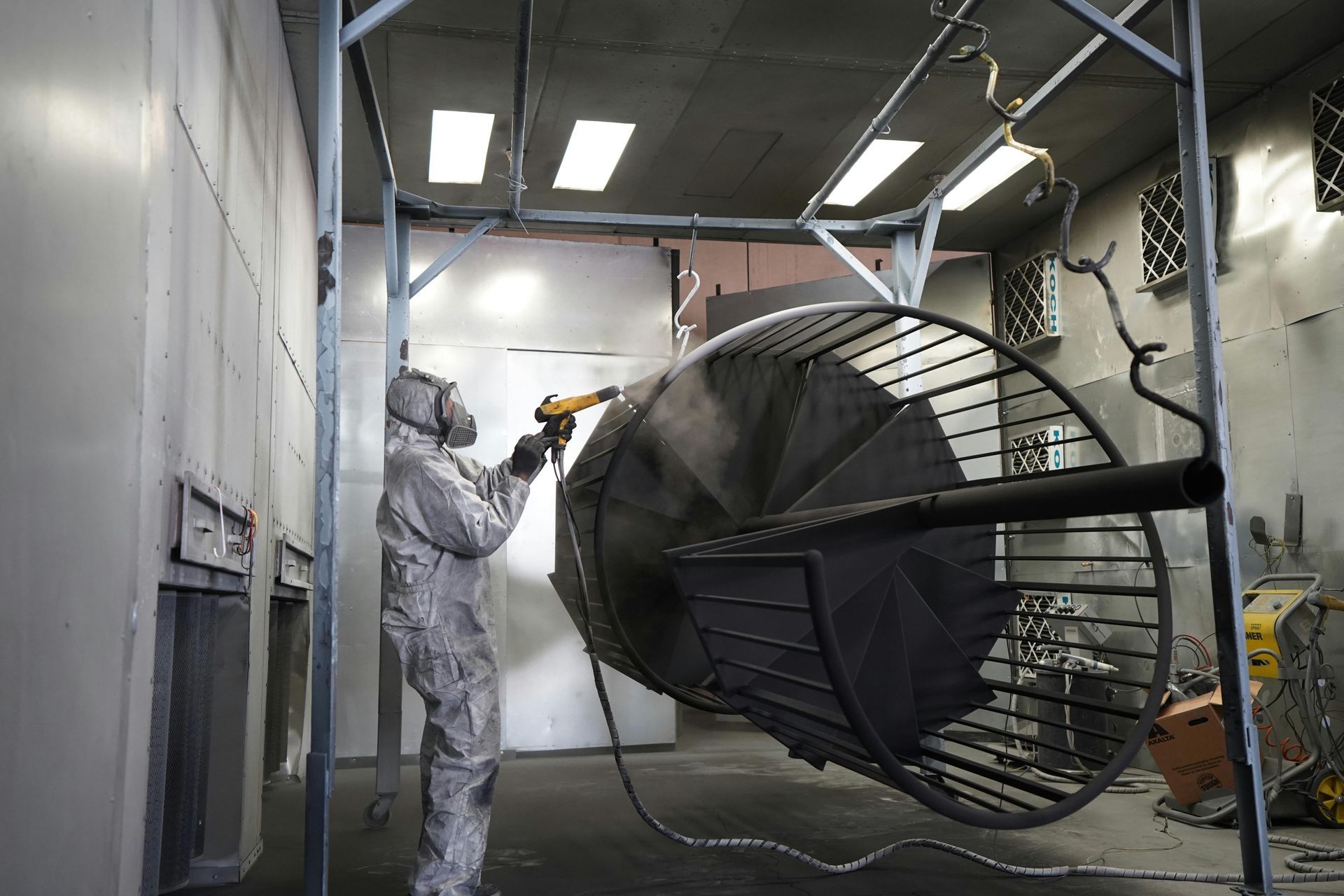
Be wary of any quote that amounts to a wipe-down and a spray. We inspect every part that comes into the shop, then sandblast or media blast it before coating. On stainless that inspection matters, since prior coatings, surface condition, and weld quality vary so much from part to part.
Blast Prep: Getting Stainless Clean Without Contaminating It
Media cautions for stainless
The blast media itself can become a problem. Hempel's technical guideline for stainless steel, written for industrial protective coatings rather than powder specifically, says stainless is susceptible to attack by chlorides and zinc, so abrasives used on it should be free of both. It also advises avoiding abrasives that contain metallic iron, because particles deposited on the surface can cause discoloration.
On profile in general, the Prismatic Powders part-preparation guide (general guidance, not stainless-specific) notes that 100 grit garnet or aluminum oxide gives a toothy profile for strong adhesion, while glass bead of the same size leaves a smoother, rounder profile that does not promote the same adhesion.
Which media suits your parts is a per-job decision, so ask about it when you request a quote. You can read about our sandblasting service and media blasting service on the site.
Why you cannot just scuff and shoot
Hand sanding or a solvent wipe can be acceptable on some metals in some conditions. On a smooth stainless surface, especially a part going outdoors, a light scuff is uneven and shallow, and any spot the sandpaper missed gives the powder nothing to grip.
The less obvious danger is trapped contamination. Welds, seams, capped tube ends, and recessed pockets can hold oils, grease, and fluids left from fabrication or earlier use. That residue can work its way out during the cure and show up as defects in the finish, which is why our published warranty does not cover defects from hidden oils, greases, or parts that hold fluids in recesses. For a wider look at surface prep and adhesion testing, Products Finishing has a useful piece on surface preparation for best powder adhesion. It describes media blasting, an alkaline degrease, and a passivation step, then coating promptly, with a crosshatch test to check adhesion.
For a side-by-side of how stainless behaves compared with aluminum, mild steel, and galvanized steel, see our overview on whether the type of metal matters when powder coating.
Passivation: a separate step to ask about
Passivation is a chemical treatment for stainless that removes free iron from the surface, and it is separate from blasting. Products Finishing places it after blasting and degreasing and before coating. Whether it belongs in the plan for your part, and how it would be handled, is something to ask about rather than assume.
When Coating Stainless Is Worth It
Stainless already resists rust, so why coat it? A few reasons can justify it.
Color and finish matching. A stainless railing section or bracket set often has to match a powder coated steel assembly nearby. A black handrail system where the stainless brackets and posts need to blend in is one example. Powder comes in a wide range of colors and finishes, so mixed materials can end up with one consistent look.
Extra surface protection in harsh settings. Stainless resists rust but it is not immune to surface staining, especially around salt, chlorides, or constant moisture. Road salt, sprinkler spray, and long outdoor exposure in Northern Utah are all part of that picture. A coating adds a barrier over the metal's own defenses. We will not quote lifespan numbers, since results depend on the part, the prep, and the exposure.
Common candidates. Railings and handrails, brackets and fabricated assemblies, trim pieces, equipment housings, and automotive and recreation hardware are the kinds of stainless parts that may be worth coating.
When Powder Coating Is a Poor Fit for Stainless Parts
Some stainless should stay bare.
Architectural stainless where the finish is the point. A polished handrail meant to stay bright or a designer feature piece loses its purpose under a coating. If the bare metal look is the design intent, leave it alone.
Food-contact and sanitary surfaces. Where a surface is specified as bare stainless for cleanliness, do not assume a coating is acceptable. Confirm with us before you plan the job.
Spec-driven documentation. If your project requires certified coating systems or paperwork to meet a specification, raise that before drop-off. Do not assume documentation is available.
Heat-sensitive assemblies. Our powder coating page describes curing at 350 to 400 degrees. Anything attached to your part that cannot take that heat, such as rubber, plastic, bearings, electronics, or adhesives, must come off first. We get into the numbers in our article on the temperature required for powder coating. If cure heat rules out conventional powder for your part, ask about our Cerakote finish, which our site describes as suited to parts exposed to extreme temperatures.
Design and Weld Details That Make or Break the Coating
These points come from our published warranty, and they are the details most likely to decide whether your coating holds up.
Sharp edges must be rounded before drop-off
Powder pulls thin over sharp edges, so a knife edge on a bracket or railing post ends up with the thinnest coverage on the part, right where chips and corrosion start. Edges need to arrive broken or rounded by the fabricator. We do not round edges, so this is a before-drop-off task.
Welds, seams, and capped tubes
Handrails and fencing need to be welded solid. Gaps and open seams hold moisture in places the powder cannot reach, and our warranty does not cover rust that builds up there. Overlapping metals and non-sealed welds are flagged in our warranty for the same reason: a crevice that holds moisture is a weak point the coating cannot reach.
Capped tubes need weep holes. Our warranty notes that without one, vapors can escape during the cure and damage the finish in the oven, and a small weep hole gives them a way out.
How these details affect the warranty
Our coverage is a 12-month limited warranty on powder coated surfaces for cracking, peeling, and extreme fading from normal climatic exposure, with published exclusions. Rounded edges, solid welds, and weep holes are part of what keeps a part inside that coverage.
Primer on Outdoor Stainless
Our warranty recommends primer on all aluminum parts and all outdoor metal, so outdoor stainless railings and hardware fall under it. The warranty also lists declined recommended surface prep and declined recommended powder chemistry among the things that void it, and it is void on parts that are not blasted.
The practical reason is that outdoor parts deal with UV, moisture, temperature swings, and impact, and a primer suited to the substrate and exposure adds a layer between the metal and the color coat. If you are weighing which steps to skip to save money, talk it through before the job starts, because skipped steps can put the warranty at risk.
Northern Utah Exposure: Freeze-Thaw, Salt, Sprinklers, and UV
Utah is hard on coatings in predictable ways.
Freeze-thaw cycles. Moisture that works into a seam, a capped tube, or a chip in the coating freezes, expands, and widens the opening. Repeated all winter, small flaws grow. That is why solid welds and weep holes matter so much here.
Road salt. Winter salt spray lands on automotive parts, stair railings, and anything near driveways and roads. The warranty page lists salt water and industrial chemicals among its exclusions, so if your part will sit in salt spray, ask how that exposure would be treated.
Sprinklers. Sprinkler systems, chlorine, and fertilizers are also listed on the warranty page among the exposures that void it. If a part sits in sprinkler range, mention it when you ask for a quote and plan placement accordingly.
UV. Strong sun is hard on any finish, and extreme fading from normal climatic exposure is among the things the 12-month limited warranty covers, within the limits on the warranty page.
We work with customers across Northern Utah and Uinta County, Wyoming (see our service areas), so these exposures are the ones we plan around.
Planning Your Job: Photos, Quotes, and Drop-Off for Stainless Parts
A few details make a quote faster and more accurate:
- Photos from several angles, with close-ups of welds and edges.
- The grade of stainless, if you know it. 304 and 316 are common grades, and it helps to know which you have.
- The current finish. Brushed, polished, mill finish, or previously coated, plus any paint or coating that has to come off.
- Weld condition. Solid welds, skip welds, capped tubes, and whether weep holes exist.
- Size and whether it comes apart. Oven fit is confirmed at the estimate.
- Where the part will live. Indoors, outdoors, near salt or sprinklers. That drives primer and media recommendations.
Before the parts travel, have the edges rounded or broken by the fabricator, remove rubber, plastic, bearings, and other heat-sensitive pieces, and make sure welds on handrails and fencing are solid with weep holes drilled in any capped tubes.
Get a Free Quote for Your Stainless Steel Parts
If you are deciding whether to coat a stainless railing, bracket set, trim, or housing, the quickest path is a conversation. Request a free quote through our contact page, call 801.631.1708, or email service@fullblowncoatings.com. Bring photos and part details, and we will go through blast, media, and primer for your parts.
You can drop parts off at 9479 South 500 West, Sandy, UT 84070 (behind Titan Cabinetry).
Share This Post!