Commercial Powder Coating Prices | Coating Prices
TL;DR
- Commercial powder coating prices are usually based on part size, surface area, geometry, condition, prep requirements, coating type, masking, and production volume, not just a flat menu price.
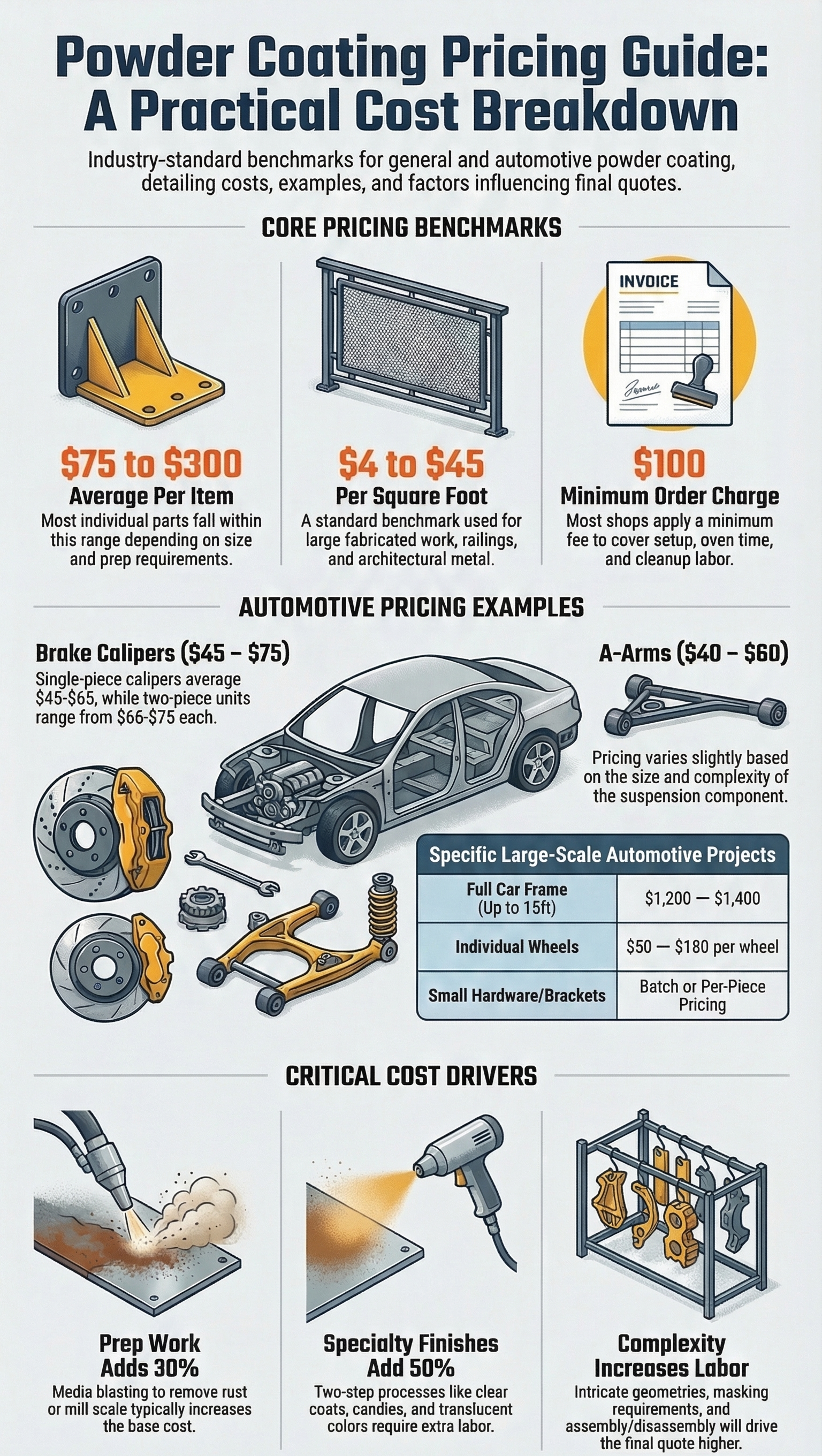
- A rough industry-style benchmark can range widely, and one source notes powder coating may run about $4 to $45 per square foot depending on the job, but real commercial quotes often depend more on production efficiency and prep than on square footage alone.
- Media blasting can materially affect the final price. One source notes that blasting rust or mill scale can increase cost by about 30% in some cases because of the labor and prep involved.
- Small jobs can feel expensive because many shops use minimum order charges and color-change charges, especially when setup and cleanup time are disproportionate to the part count. One source lists a $100 minimum order and $25 minimum per color change as examples.
- Specialty finishes such as clear coats, translucent colors, anodized-style looks, and candy-style systems often cost more because they require a two-step process. One source says these can add about 50% to the price.
- For commercial buyers, the lowest quote is not always the best quote. What matters is whether blasting, masking, stripping, disassembly assumptions, coating specs, and finish expectations are clearly included. This is an inference based on the cost variables emphasized by both sources.
Commercial Powder Coating Prices: coating prices, powder coating price, and What Businesses Should Expect
When businesses search for powder coating price information, they are usually not trying to price a single decorative part. They are trying to understand real coating prices for commercial and industrial work such as railings, equipment frames, fabricated metal components, structural parts, architectural pieces, fleet hardware, and recurring production runs. For companies in Salt Lake County, Davis County, Utah County, and Weber County, the real question is usually not just how much powder coating costs, but what drives the price and how to get the best long-term value from the finish.
That is important because commercial powder coating quotes are rarely based on one factor alone. Part size matters. Surface condition matters. Complexity matters. Prep matters. Coating selection matters. And when media blasting, sand blasting, masking, stripping, and repeat production are involved, the final number can move quickly.
What Are Commercial Powder Coating Prices Based On?
Part Size and Surface Area
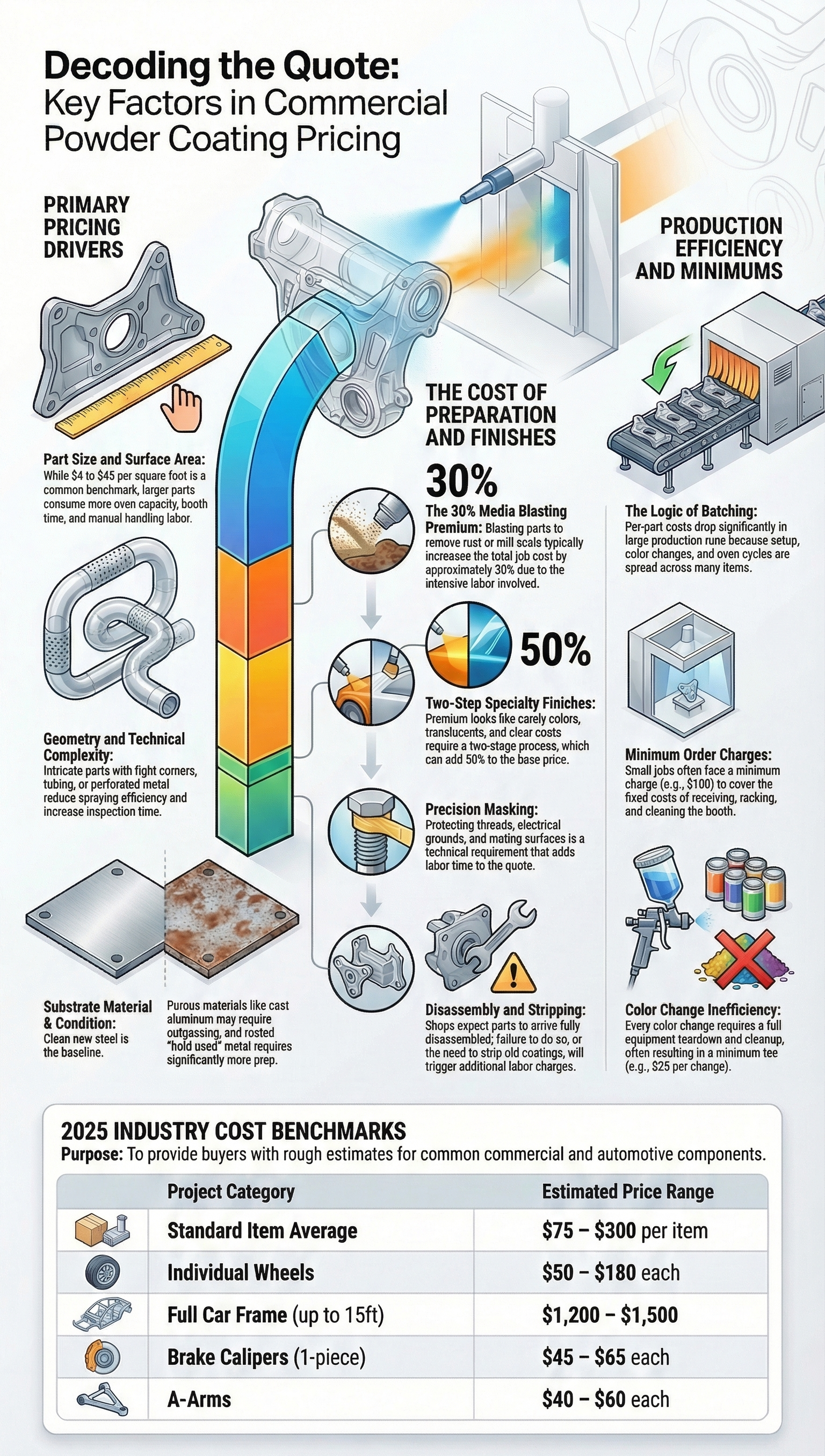
One of the biggest pricing factors is simply how much part needs to be coated. Larger parts use more powder, more booth time, more oven capacity, and more handling labor. One of the reference sources gives a broad powder coating cost range of about $4 to $45 per square foot, which helps illustrate how wide the pricing spread can be depending on the project.
That said, commercial work is not always priced neatly by square foot. Shops may quote by the part, by the batch, by the production run, or by the project. A flat panel, a handrail, and an intricate fabricated assembly may all have similar surface area on paper, but they will not consume the same amount of labor in the shop.
Material Type and Condition
The condition of the substrate can be just as important as size. Clean new steel is very different from rusted field-used steel. Aluminum behaves differently than cast aluminum. Previously painted or contaminated parts can require much more prep work than new bare metal. Both sources make it clear that surface condition plays a meaningful role in cost.
One source also notes the issue of outgassing, which can be especially relevant with cast or porous materials. That means some commercial parts are not just more expensive because they are larger, but because they are inherently harder to coat correctly.
Geometry and Complexity
Complex parts cost more to coat than simple ones. Tight corners, tubing, perforated metal, sharp transitions, hidden surfaces, and welded assemblies can all increase labor during prep, spraying, and inspection. The more intricate the part, the less efficient the process tends to become. That is why commercial buyers should be careful about comparing quotes based only on rough dimensions.
Common Commercial Powder Coating Price Models
Per Part Pricing
Per part pricing is common when a business is coating brackets, machine covers, panels, enclosures, guards, racks, and similar repeatable items. This model is often the easiest for commercial buyers to budget around because it gives a predictable number for each SKU or component.
Per Square Foot Pricing
Square-foot pricing is more common in large fabricated work, architectural metal, railing systems, fencing, and other surface-driven projects. Even then, square footage is usually only the starting point. If the job needs blasting, masking, multi-step coating, or unusual handling, the quote can change quickly. One source’s broad $4 to $45 per square foot framing is useful as a benchmark, but not as a universal rule.
Batch and Production Run Pricing
For commercial and industrial buyers, batch pricing is often where the best efficiency appears. If many similar parts can be coated together, setup time, color setup, oven loading, and labor become more efficient. This is one reason recurring commercial jobs are often priced differently from one-off jobs. That pricing logic is an inference from the sources’ emphasis on setup costs, minimums, and color-change inefficiencies.
Minimum Charges
Small jobs are often subject to minimum charges because the shop still has to receive the parts, inspect them, prep them, spray them, cure them, and handle cleanup. One source provides an example of a $100 minimum order and a $25 minimum per color change. That helps explain why a tiny commercial touch-up batch may seem more expensive than expected.
Average Commercial Coating Prices by Project Type
Small Commercial Parts and Hardware
Brackets, covers, hardware, small weldments, and machine accessories are usually quoted per piece or per batch. If the parts are clean, uniform, and easy to rack, prices tend to be more favorable. If they arrive greasy, rusty, mixed, or partially assembled, the cost usually rises. This is consistent with the pricing drivers emphasized in both sources.
Railings, Fencing, Gates, and Architectural Metal
Architectural work often involves larger dimensions and more visible finish expectations. Buyers are not only paying for coverage, but for appearance quality, handling care, and coating consistency. Weld cleanup, surface prep, transport, and rack strategy all affect cost. In many commercial jobs like these, the finish quality matters just as much as raw protection.
Industrial Equipment and Machine Components
Equipment frames, guards, enclosures, carts, racks, and structural components often bring additional quoting considerations. Masking may be more technical. Contact surfaces may need protection. Tolerance-sensitive areas may need to remain uncoated. If the parts are mission-critical, quality control expectations may also be higher.
Fleet and Commercial Vehicle Components
While one of the source articles leans more automotive, the same pricing principles carry over into fleet and commercial vehicle work. Bumpers, racks, toolboxes, and trailer components still vary in cost based on size, prep, complexity, and finish system.
Why Media Blasting Changes Powder Coating Price
What Blasting Adds to the Job
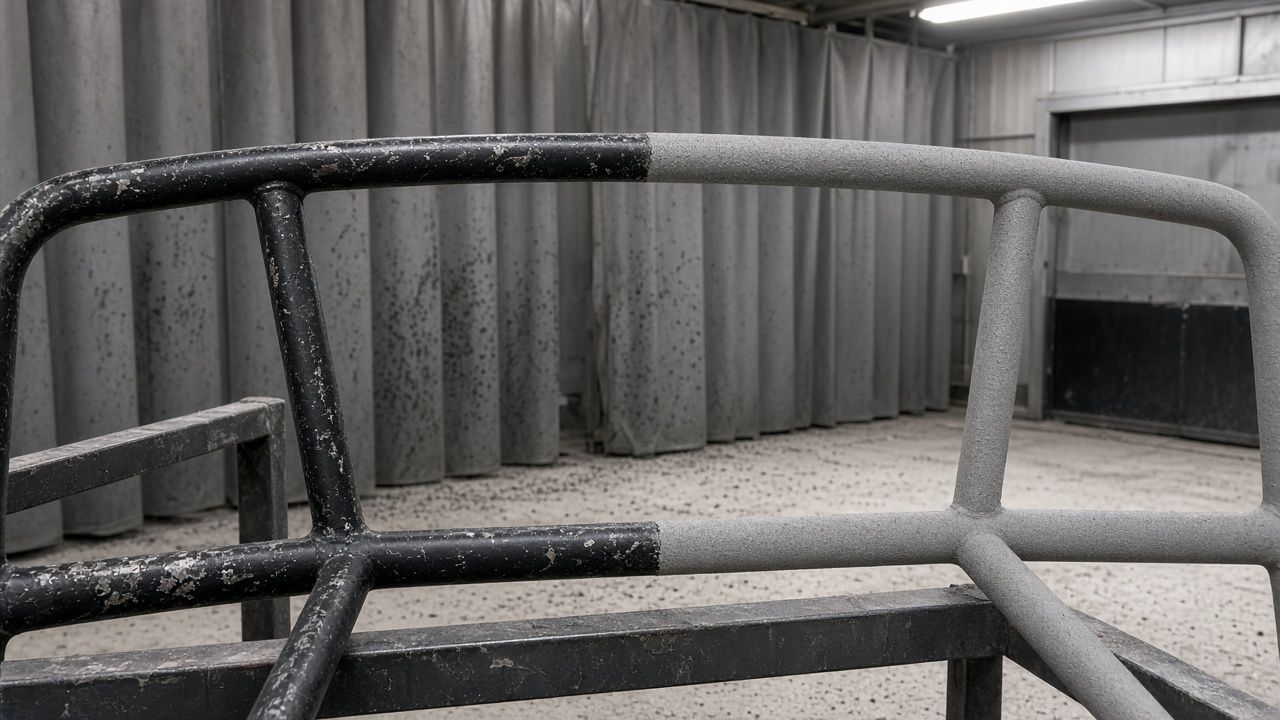
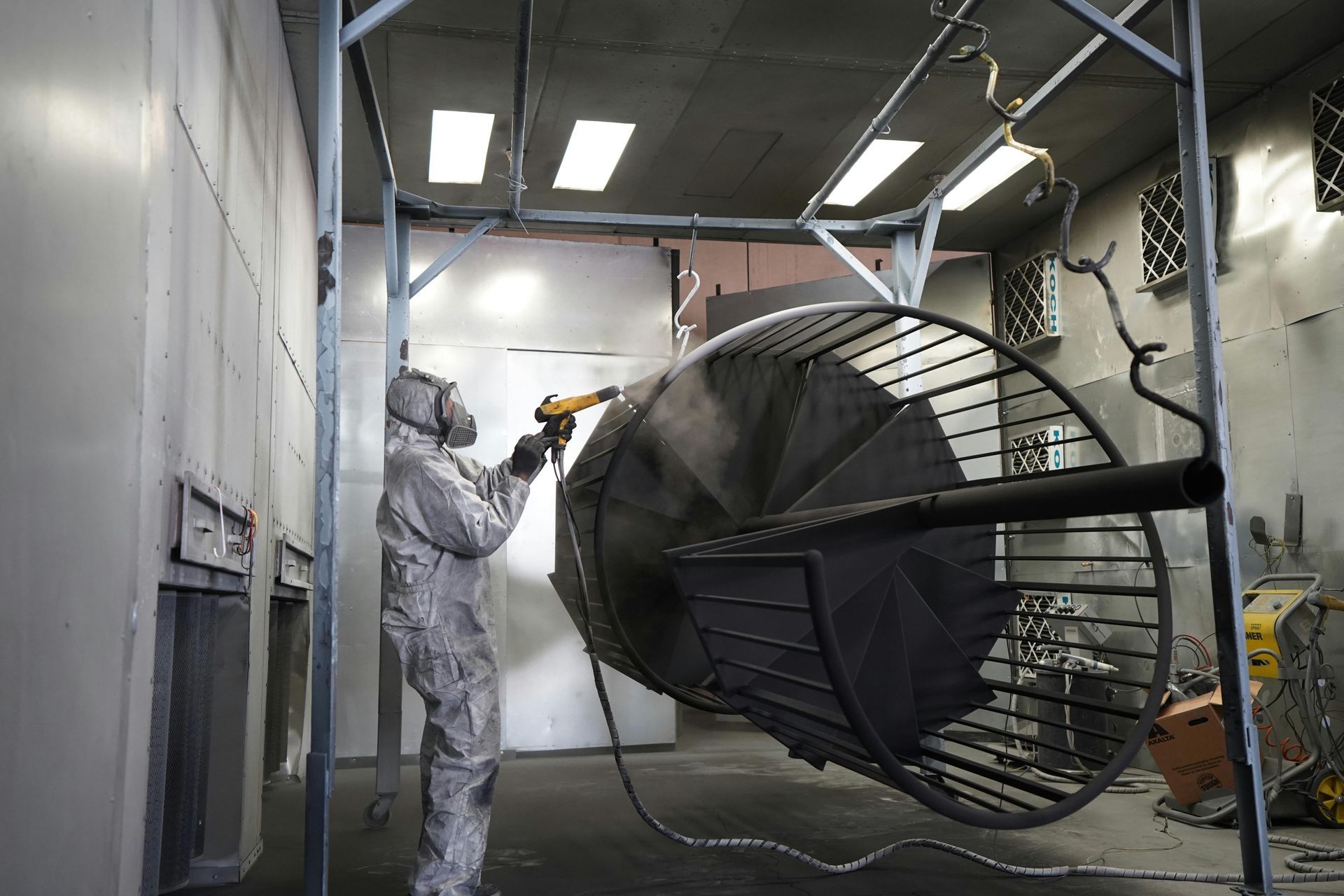
Media blasting is one of the most important cost variables in commercial metal finishing because it removes rust, mill scale, failed coatings, and contamination while creating a better surface profile for coating adhesion. It is not just an extra step. In many cases, it is what makes the coating system worth doing in the first place.
When Blasting Is Necessary
If parts arrive with rust, old paint, scale, corrosion, or heavy contamination, blasting may be essential. One source notes that blasting rust or mill scale can increase powder coating cost by about 30% in some cases.
That figure is useful because it shows how much prep matters. In the commercial world, buyers sometimes focus on coating price alone and overlook prep. At Full Blown Coatings, that is often where the real discussion starts. A clean, ready-to-coat batch of fabricated parts is one kind of job. A heavily corroded set of field-used steel components is another. They may end up the same color in the end, but they are not the same quote.
Why Skipping Prep Can Cost More Later
Poor prep can lead to early coating failure, poor adhesion, inconsistent appearance, and more rework. This is an inference based on the strong emphasis both sources place on substrate condition, stripping, blasting, and prep-related variables.
Specialty Finishes and Color Changes
Standard Colors vs Premium Looks
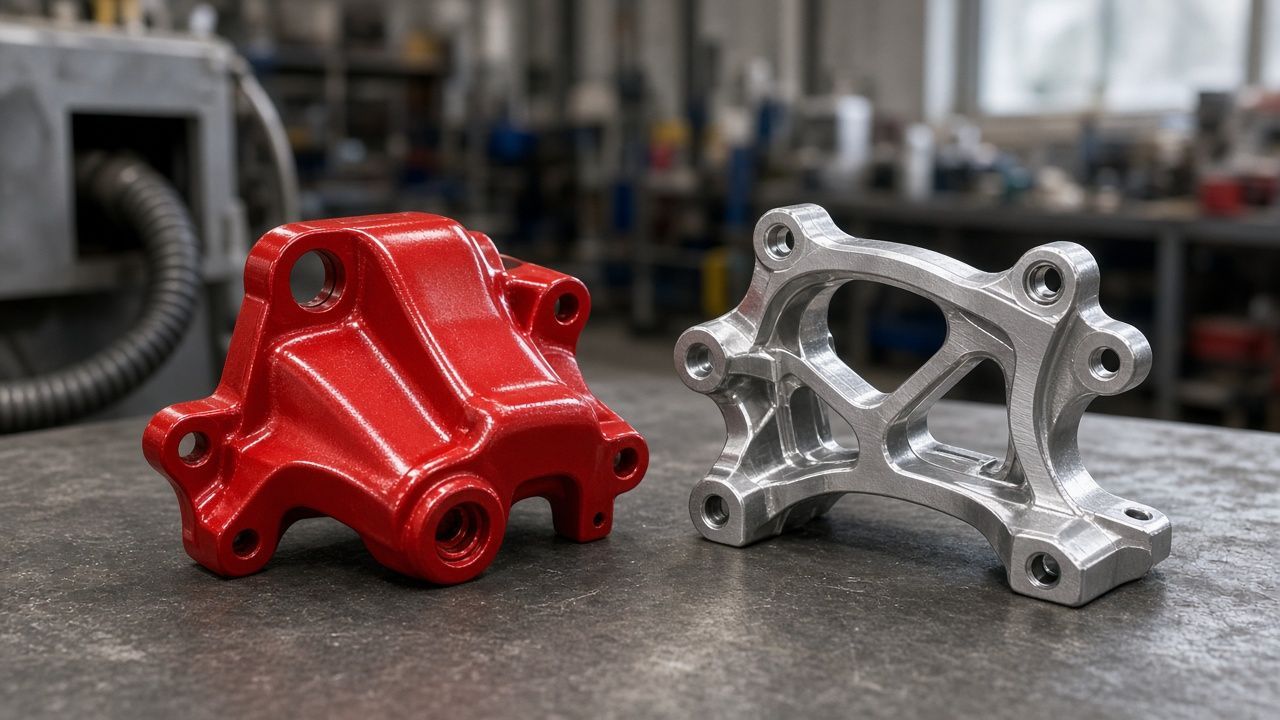
Standard single-coat systems are usually the most economical. Once a buyer moves into metallics, textures, specialty aesthetics, or premium appearance-driven finishes, cost tends to rise because the process becomes less straightforward.
Two-Step Systems
One source explains that clear coats, translucent finishes, anodized-style looks, and candy colors often require a two-step process and may add around 50% to cost. For commercial buyers, this matters because appearance upgrades can affect both labor and material significantly.
Color Changes in Production
Color changes are not free. They require cleanup, scheduling, and process interruption. One source’s $25 minimum per color change example helps illustrate why batching similar parts by color can reduce costs in commercial work.
Hidden Cost Drivers Businesses Often Miss
Masking
Masking is a big one. Threads, electrical grounds, mating surfaces, and tolerance-sensitive areas may all need to be protected. One source specifically references thread masking in its pricing assumptions, which is a good reminder that masking is often a technical requirement, not just a cosmetic preference.
Stripping Existing Coatings
Removing old finishes adds labor and can require blasting, chemical stripping, or other prep work. The source content makes clear that substrate condition and pre-existing coatings are major pricing variables.
Disassembly and Logistics
One source notes that parts are expected to be fully disassembled and that extra charges may apply when they are not. For commercial buyers, that translates into a simple rule: organized, ready-to-process parts cost less than messy, partially assembled drop-offs.
Powder Coating vs Painting for Commercial Metalwork
For many commercial metal parts, powder coating offers strong durability, finish consistency, and repeatability. That can make it an attractive option for production work and long-term use. Wet paint may still make sense in some oversized or field-applied applications, but buyers should compare lifecycle value, not just the initial invoice. This lifecycle comparison is an inference from the sources’ emphasis on coating durability, finish systems, and process cost drivers rather than a direct quoted claim.
How Businesses Can Lower Commercial Powder Coating Costs
Standardize Colors
Using fewer colors can reduce setup inefficiency and avoid unnecessary color-change charges.
Batch Similar Parts Together
Larger, more uniform runs are generally more efficient than one-off pieces. This is a practical inference supported by the sources’ focus on minimums, setup, and process-driven cost.
Send Fully Disassembled Parts
Ready-to-process parts reduce shop labor and quoting friction. One source directly notes extra charges when parts are not disassembled.
Address Heavy Contamination Early
Removing excessive oils, loose debris, or obvious issues before drop-off can help streamline prep and reduce surprises.
Final Thoughts on coating prices and powder coating price
The biggest mistake commercial buyers make is assuming powder coating has a universal menu price. In reality, commercial powder coating prices depend on a web of interacting variables: part size, condition, complexity, prep, masking, finish selection, and volume. Both reference sources make that clear.
So when comparing coating prices or trying to estimate a powder coating price, focus on what is actually included. Is blasting included? Is masking included? Is stripping included? Are specialty finishes extra? Is the quote based on one-off handling or production efficiency? Those questions matter more than any single headline price.
For businesses in Salt Lake County, Davis County, Utah County, and Weber County, the best commercial powder coating partner is usually the one that understands not just how to spray powder, but how to evaluate prep, process, and finish performance from the start. That is how you get a quote that makes sense and a finish that lasts.
Share This Post!