How Is the War in Iran Affecting the Powder Coating Industry? Supply Chain, Resin Costs, and What It Means for Powder Coating Services
TL;DR:
- The Iran war is affecting the powder coating industry mostly through higher oil, gas, freight, insurance, and polymer-related costs rather than through a direct shutdown of local coating shops.
- The Strait of Hormuz carries about 20 million barrels of crude and refined products per day, roughly 20 percent of global oil consumption, and nearly 20 percent of LNG exports, so disruption there can quickly raise energy and transport costs.
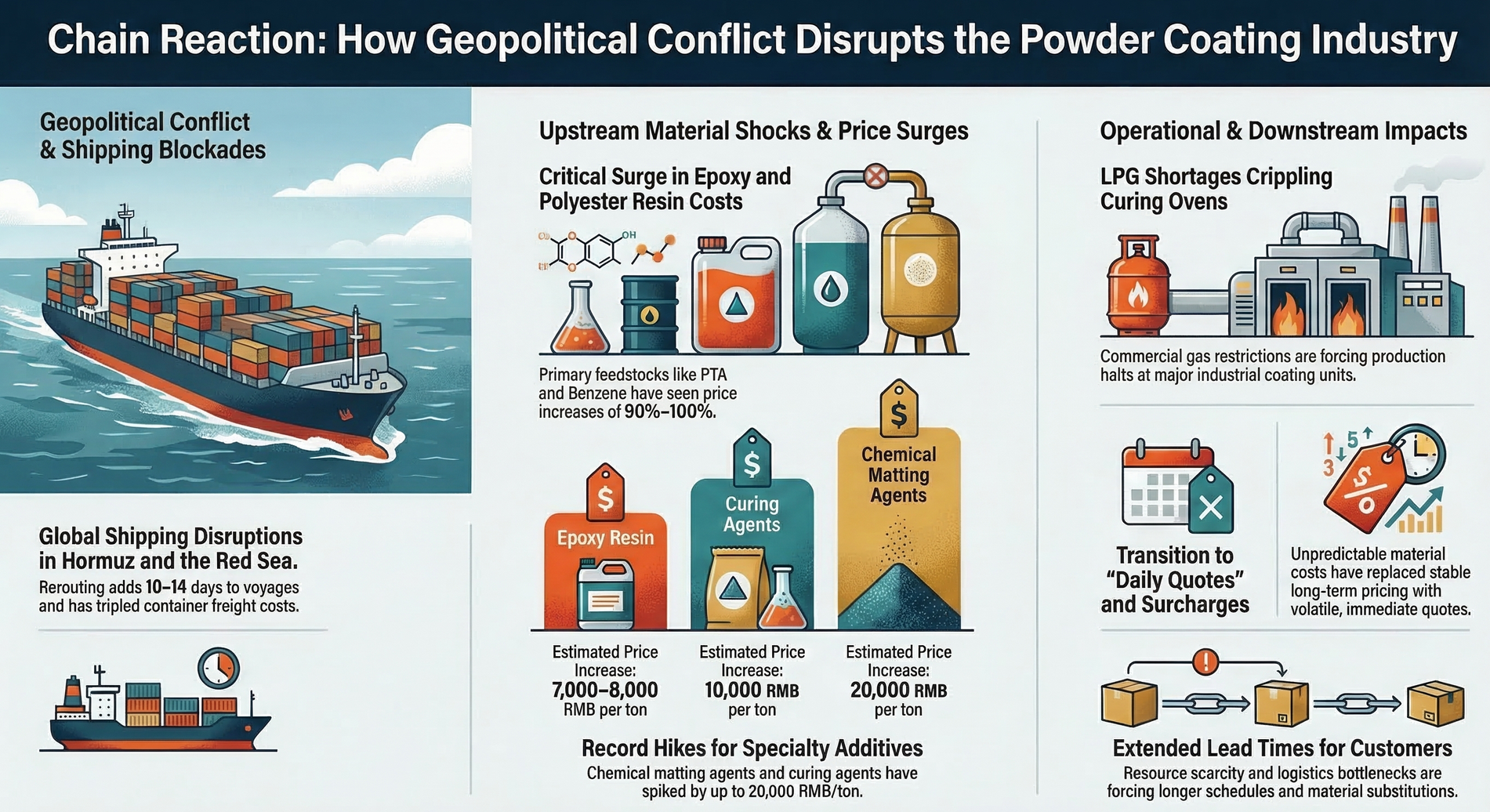
- Red Sea rerouting previously added 3,000 to 3,500 nautical miles and 10 to 14 days to Asia-Europe routes, while war-risk insurance and freight costs surged. That kind of disruption can ripple into coatings, additives, and raw-material lead times.
- WACKER announced on March 13, 2026 that the Middle East conflict had caused “significant disruption in global supply chains,” and said it would raise prices for dispersions, resins, and dispersible polymer powders effective April 1, 2026.
- For powder coating customers, the most likely effects are quote volatility, longer lead times on certain colors or chemistries, and more material substitutions on specialty jobs. That is an inference based on the cited shipping, energy, and polymer cost pressures.
- Media blasting is more local and labor-driven than powder manufacturing, but because blasting and coating are often bundled together, higher coating-material costs can still raise full project pricing. This is an inference from how finishing shops typically package services.
How Is the War in Iran Affecting the Powder Coating Industry? Supply Chain, Resin Costs
When people ask how is the war in Iran affecting the powder coating industry, they are really asking a bigger question about cost, timing, and reliability. For customers looking for powder coating services, industrial powder coating, media blasting, or metal finishing services, the issue is not usually that powder coaters suddenly stop operating. The issue is that powder coating sits at the end of a long global supply chain that depends on energy markets, chemical feedstocks, shipping routes, resin production, and freight stability. When those upstream systems get stressed, local coating quotes and lead times often feel the impact next.
That is why this conflict matters to a finishing shop in the United States even if the shop never imports directly from Iran. Chemicals United explains that the Strait of Hormuz is one of the world’s most important energy chokepoints, and that the Red Sea crisis showed how quickly rerouting, freight spikes, and insurance increases can strain chemical supply chains. WACKER has already tied the Middle East conflict to materially higher raw-material and logistics costs in its own polymers business.
Why the Iran War Matters to the Powder Coating Industry
Powder coating depends on more than powder
A lot of customers think of powder coating as a local shop service with local pricing. In reality, the coating itself depends on raw materials and chemical intermediates that are affected by global commodity markets. WACKER’s March 2026 announcement is a useful signal here because its polymers division supplies products used in paints, surface coatings, adhesives, and related industries. When a large polymer producer says the conflict has significantly raised raw-material and logistics costs, that is not abstract news for the coatings world. It is an upstream warning sign.
For powder coating specifically, the main concern is not that one ingredient disappears overnight. It is that resin and additive costs, transport costs, and supply reliability become less predictable at the same time. That is what makes buyers and shops uneasy. A finishing process can tolerate stable high costs better than unstable moving costs.
The problem starts with energy and shipping
Chemicals United says the Strait of Hormuz handles about 20 million barrels of crude and refined products per day, roughly 20 percent of all oil consumed worldwide, and nearly 20 percent of LNG exports. It also notes that alternative pipeline routes can handle only a limited share of that volume. That matters because powder coating raw materials, packaging, freight, and plant operations all sit downstream of energy pricing. If energy jumps sharply, pressure spreads through the whole manufacturing chain.
The Red Sea side of the story matters too. Chemicals United says the earlier crisis forced carriers to bypass the Suez Canal and route around the Cape of Good Hope, adding 3,000 to 3,500 nautical miles and 10 to 14 days to Asia-Europe voyages. Freight costs and war-risk insurance also climbed sharply. Even if a U.S. powder coater buys from a domestic distributor, that distributor may still depend on globally sourced materials or components somewhere in the chain.
The Direct Cost Pressures on Powder Coating Materials
Oil and natural gas prices raise the floor
When oil and gas prices rise, the effect is broader than fuel at the pump. Chemicals United says analysts warned a Strait of Hormuz closure could add $2 to $5 per barrel to transport costs and potentially push oil prices $30 to $70 per barrel higher. Powder coating manufacturers and related chemical suppliers may feel that through utilities, feedstocks, and shipping all at once.
For customers, the practical takeaway is simple. Even if your local powder coating shop is stable and well-run, it cannot fully insulate itself from higher material and freight costs forever. This tends to show up in shorter quote-validity windows, more cautious scheduling, and more frequent repricing.
Resin and polymer pressure is already visible
WACKER was unusually explicit about the cause-and-effect chain. In its March 13, 2026 press release, it said the military conflict in the Middle East had led to “significant disruption in global supply chains” and that oil, natural gas, raw materials, and logistics had all become significantly more expensive. It then announced price increases for polymer dispersions, resins, and dispersible polymer powders effective April 1, 2026.
That matters because the powder coating industry is connected to the broader coatings and polymers ecosystem. Not every WACKER product goes into powder coating directly, but price action at that level tells you the upstream environment is already stressed. For buyers, this is often the point where a local metal finisher may start saying things like:
- this color is available but no longer at last month’s price
- the lead time on specialty material has stretched
- a standard resin system is easier to source than a niche one right now
Those are exactly the kinds of ripple effects customers notice first.
Freight and insurance are not side details
Chemicals United says container prices to Europe tripled during the Red Sea crisis and that war-risk premiums for Red Sea transit rose from roughly $10,000 to $20,000 per voyage up to $150,000 to $500,000. It also says some chemical freight rates became three times more expensive and effective vessel capacity dropped.
For powder coating buyers, this means material costs can rise even if the chemistry itself did not suddenly become rare. Sometimes the problem is simply that moving the product became slower, riskier, and more expensive.
How This Affects Powder Coating Shops and Customers
Higher job pricing and less pricing stability
The most immediate effect is not necessarily a dramatic price spike on every order. More often, it is less pricing stability. Shops that used to quote comfortably for longer periods may tighten validity windows because their suppliers are updating costs more often. This is a reasonable inference from the higher raw-material and logistics costs reported by Chemicals United and WACKER.
At Full Blown Coatings, this kind of market usually changes the customer conversation. Instead of only talking about finish type, color, and turnaround, the conversation starts including material timing, whether a common color will work instead of a specialty one, and whether the customer wants to lock in a larger run sooner rather than later.
Longer lead times on specialty systems
Standard blacks, whites, and common textures are usually easier to source than niche chemistries, custom colors, or unusual performance systems. When shipping lanes are fragile and upstream polymer suppliers are raising prices, specialty finishes become more vulnerable to delays or substitutions. That is not a direct statement from the sources, but it is a practical inference from the kind of supply pressure they describe.
This matters most for:
- architectural packages that need exact consistency
- recurring industrial runs with spec-driven powders
- multi-phase jobs that need the same color later
- custom aesthetic work with less common materials
More substitutions and spec conversations
In a stable market, a buyer may simply request a certain finish and move forward. In a volatile market, the shop may need to ask:
- Does this need to be this exact chemistry?
- Is there an acceptable alternate finish?
- Can this be run in a more available standard color?
- Can the project be phased differently?
That extra decision-making can feel inconvenient, but it is often what keeps a project moving.
Why Feedstocks Matter Even if You Never Buy Chemicals
Chemicals United says Iran is a top supplier of methanol and a significant exporter of ammonia, urea, and polymers. It also notes that disruptions to Iran’s ports or the Strait of Hormuz could tighten global supplies of these feedstocks and raise prices.
Most powder coating customers will never buy methanol or polymer feedstocks directly. But that is not the point. The point is that powder coatings, paints, coatings additives, packaging materials, and industrial consumables all sit downstream of chemical production chains. When upstream inputs tighten, downstream products often become more expensive, less available, or slower to deliver.
Is the Impact the Same for Every Powder Coating Job?
Small custom jobs versus production runs
Small custom jobs may feel the impact as a quote change, but large production runs usually feel it as a planning problem. If a manufacturer needs repeat quantities over time, then material consistency and future availability matter more than a one-time price bump. This is an inference from how supply volatility affects different buying patterns.
Standard colors versus specialty systems
Common systems usually have better supply resilience. Specialty systems usually have less margin for disruption. So a shop may be able to keep basic production moving while asking for more flexibility on less common finishes.
Blasting versus coating
Media blasting is less exposed to global polymer markets than powder manufacturing is, because blasting is more labor-, equipment-, and media-driven. But many finishing projects bundle blasting and coating together, so a customer may still see the full project cost rise even if blasting itself was not the volatile component. That is a practical inference from how finishing services are sold.
What Customers Should Ask Right Now
If you are ordering powder coating during a volatile supply period, ask better questions upfront:
Ask whether pricing is locked
A quote that was fine for weeks in a calm market may not stay valid as long in a disrupted one.
Ask whether the finish is readily available
Do not assume every resin system or custom color is equally easy to source right now.
Ask about alternates
A good shop may be able to offer a more available coating that still performs well for your application.
Ask about timing
On larger jobs, ordering earlier can sometimes reduce risk more than trying to shave a little money off at the last minute.
Does This Change the Value of Powder Coating?
Not necessarily. Higher material costs do not automatically make powder coating a worse choice. In many applications, powder coating may still offer strong lifecycle value because durability, appearance retention, and corrosion resistance can still outweigh the cost of lower-performing alternatives. That is an inference, but it is a practical one for commercial buyers weighing total ownership cost.
What it does change is the importance of getting the process right the first time. When materials are more expensive and less predictable, rework hurts more. Good surface prep, proper media blasting, and clear communication about finish selection become even more valuable.
Final Thoughts
The Iran war is affecting the powder coating industry less through dramatic shop-floor shutdowns and more through a chain of upstream pressures: energy risk, freight instability, war-risk insurance, polymer cost increases, and feedstock uncertainty. Chemicals United provides the shipping and energy context, while WACKER provides a concrete example of conflict-driven price increases already reaching the polymers market.
For customers, the smart response is not panic. It is better planning. Expect some quote sensitivity. Expect some lead-time pressure on specialty materials. Ask more questions earlier. And work with a powder coating and metal finishing partner that can communicate clearly when supply conditions change.
In volatile markets, the best shop is not just the one that sprays powder well. It is the one that helps you make good decisions before volatility becomes your problem.
Share This Post!