Performance Powder Coating and Quality Powder Coating
TLDR:
- Quality Powder Coating and Performance powder coating are not just marketing phrases. They refer to finishes that are properly prepped, correctly applied, fully cured, and matched to the part’s real environment.
- A coating can look good and still fail later if prep, adhesion, film thickness, or cure are wrong. The Powder Coating Institute says adhesion depends heavily on substrate cleanliness, pretreatment, and proper melt and cure.
- Good media blasting and pretreatment are foundational because they remove contamination, improve adhesion, and help control corrosion under the finish.
- Film thickness matters both visually and technically. IFS says constant, level film thickness affects how the coating looks and how it performs overall.
- “Performance” depends on the use case. Indoor shelving, exterior railings, architectural panels, and industrial equipment do not all need the same powder chemistry or performance level.
- High-quality powder coating usually costs more than low-bid work because it includes better prep, better process control, and better verification of thickness, adhesion, and cure. This is an inference based on the cited quality-control and pretreatment guidance.
Quality Powder Coating and Performance Powder Coating: What Actually Makes a Finish Last
When people search for Quality Powder Coating or Performance powder coating, they are usually looking for more than a part that looks good for a week. They want a finish that holds up. They want strong adhesion, real corrosion resistance, consistent color and texture, proper edge coverage, and a coating system that fits how the part will actually be used. In other words, they are not just buying color. They are buying surface preparation, chemistry selection, film control, and process discipline. The Powder Coating Institute notes that adhesion is highly dependent on substrate cleanliness, pretreatment selection and maintenance, and proper melt and cure, which is a good reminder that real quality starts long before the powder is sprayed.
A good-looking finish is part of the story, but it is not the whole story. A part can come out glossy, smooth, and visually impressive, then fail months later because the prep was incomplete, the cure was off, or the powder chemistry did not match the service environment. That is why “quality” and “performance” need to be understood as measurable things, not just sales language. IFS says quality control testing is what helps ensure a coated surface will actually perform well, not merely look good.
What “Quality Powder Coating” Really Means
It means more than appearance
The first thing most customers notice is appearance. They notice whether the finish is smooth, whether the color is even, and whether the part looks professionally done. That absolutely matters. But cosmetic quality is only one layer of real powder coating quality. The other layer is technical quality: adhesion, cure, film thickness, coverage, and the ability to hold up over time. IFS specifically says film thickness affects both how the coating looks and how it performs overall.
That is why a part can look impressive on pickup day and still not qualify as high-quality coating work. If the film is inconsistent, if the edges are weak, or if the substrate was not truly ready, the finish may already be compromised.
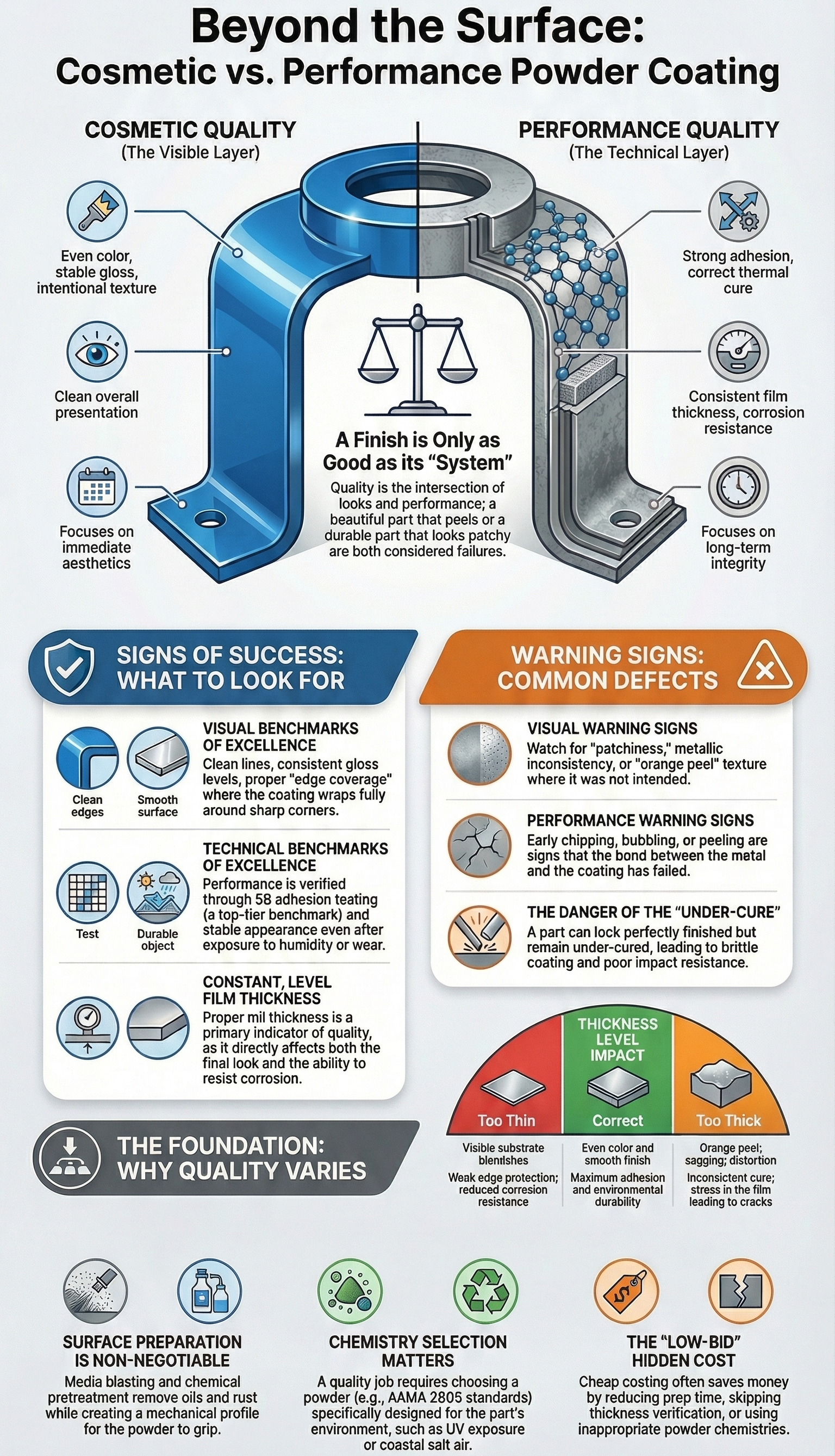
Cosmetic quality vs performance quality
Cosmetic quality includes:
- even color
- stable gloss
- intentional texture
- no obvious defects
- clean overall presentation
Performance quality includes:
- strong adhesion
- correct cure
- consistent film thickness
- adequate corrosion protection
- good resistance to wear, humidity, and service conditions
The best powder coating jobs have both. A finish that performs well but looks poor is still a problem. A finish that looks excellent but fails early is also a problem.
What “Performance Powder Coating” Means
Performance powder coating is really about fit. It means the coating system is appropriate for the part’s actual use. An indoor display rack does not need the same performance as an exterior railing near the coast. A decorative bracket does not need the same chemistry as an industrial enclosure. IFS architectural materials point to performance categories like corrosion resistance, humidity resistance, chemical resistance, and impact resistance, which shows that “performance” is a technical requirement tied to the environment, not just a general compliment.
This is where many buyers get misled. They hear that powder coating is durable and assume all powder coatings perform the same way. They do not. Chemistry, pretreatment, thickness, cure, and substrate condition all change the result.
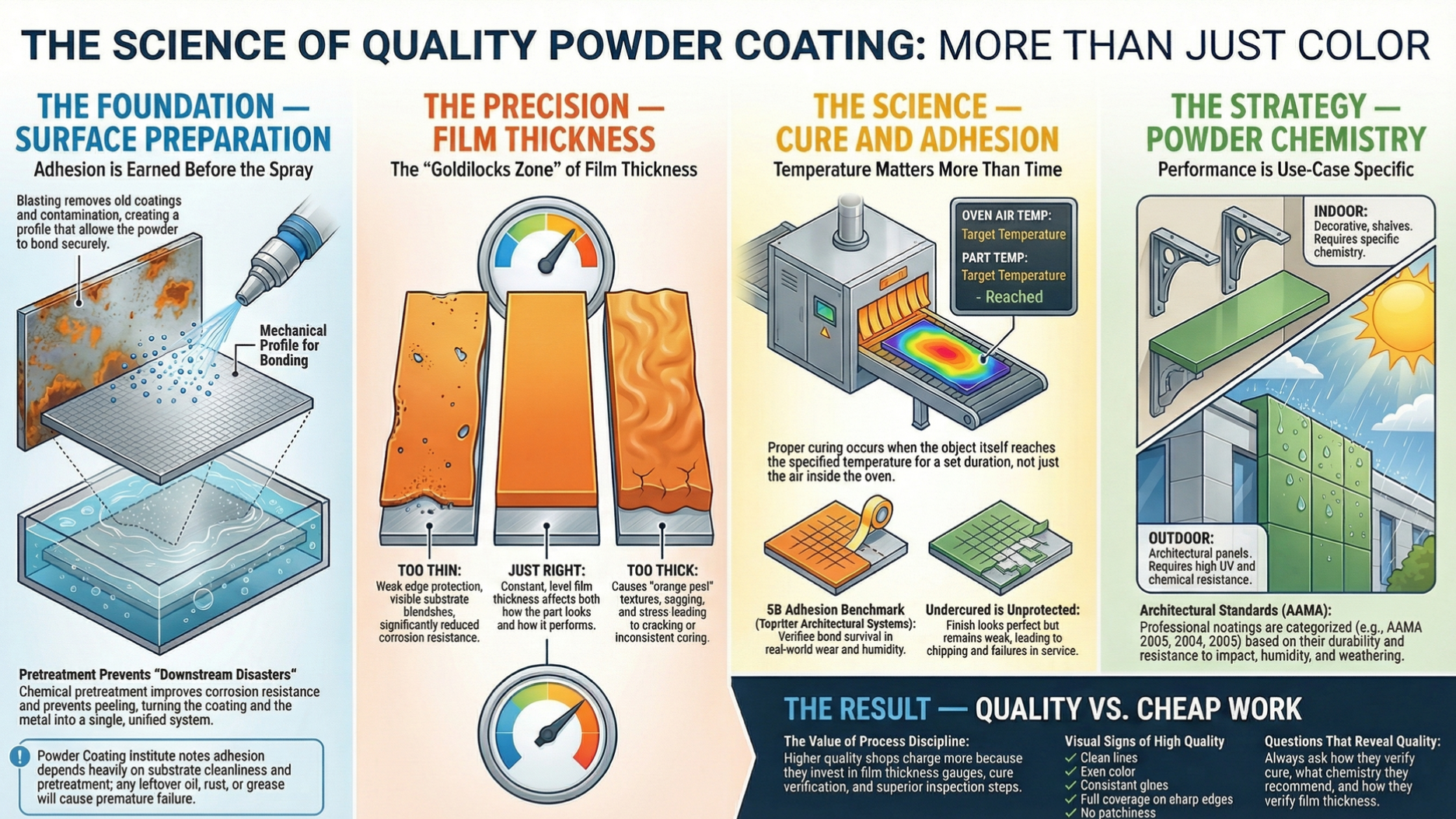
The Foundation of Quality: Surface Preparation
If there is one place where high-quality powder coating begins, it is prep. TIGER states it plainly: “Cutting corners in pretreatment can lead to downstream production disasters such as peeling, corrosion and scrap.” That is one of the clearest expert summaries of the issue.
Why prep matters so much
Any contamination between the metal and the coating interferes with adhesion. TIGER says exactly that, and the Powder Coating Institute’s guidance on adhesion points to the same chain: cleanliness, pretreatment, and cure all matter heavily.
In practical terms, prep problems include:
- oil or grease left behind
- rust or scale still on the surface
- old coating not fully removed
- flash rust after cleaning
- poor surface profile
- oxidation on the substrate
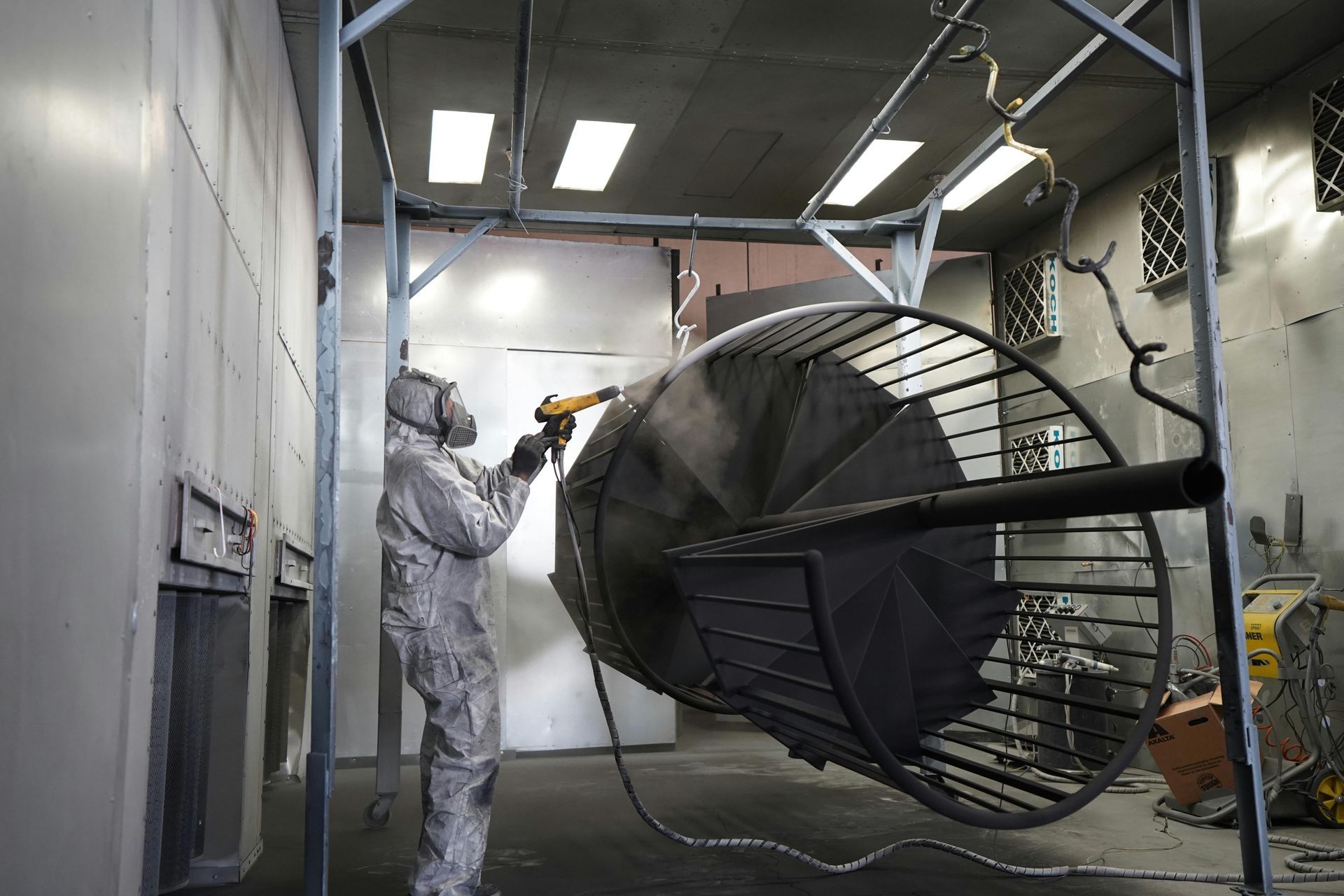
At Full Blown Coatings, this is where a lot of long-term success is decided. Customers often notice the color and texture first, but the part of the job that usually determines how long it lasts is the part they never see once the coating is on. Good blasting and pretreatment are what give the finish its chance to work.
Media blasting and pretreatment work together
Media blasting removes rust, scale, old coatings, and contamination while helping create a mechanical profile for adhesion. Chemical pretreatment adds another layer of performance by improving adhesion and corrosion resistance on clean metal surfaces. TIGER’s pretreatment guide and powder coating process explanation both emphasize that pretreatment improves adhesion and corrosion protection.
This is why the smartest way to think about coating is not “blasting first, coating second” as two unrelated tasks. It is one finish system.
Film Thickness: One of the Biggest Quality Indicators
IFS says constant, level film thickness is important because it affects both appearance and performance. That makes film thickness one of the clearest technical markers of a quality powder coating job.
Why thickness matters
If the coating is too thin, you can get:
- weak edge protection
- visible substrate blemishes
- reduced corrosion protection
- uneven appearance
If the coating is too thick, you can get:
- orange peel
- sagging
- inconsistent cure response
- appearance distortion
- stress in the film
IFS troubleshooting and appearance guidance point directly to thickness, grounding, gun distance, and equipment settings as causes of these issues.
Why buyers should care
Most customers will never walk in asking about mil thickness, but they should understand why it matters. A clean finish is not just about the right color. It is about the right amount of material on the part, applied evenly and consistently.
Cure and Adhesion: Where Performance Is Won or Lost
A finish can look good and still be undercured. That is one of the most important things buyers should understand. Cure is about the object reaching the correct temperature for the correct time, not just spending time in a hot oven. IFS troubleshooting guidance notes that cure schedule problems can show up as chipping and says the object itself must reach the correct cure temperature for the correct time.
Why adhesion matters so much
Adhesion is one of the strongest indicators of whether the whole system was done correctly. PCI states that adhesion depends on:
- substrate cleanliness
- pretreatment selection and maintenance
- proper melt and cure
That means if adhesion is weak, the problem usually started much earlier than the moment the part failed.
What strong adhesion looks like
Many technical data sheets use 5B adhesion as a top benchmark. IFS data sheets for architectural systems list dry, wet, and boiling-water adhesion at 5B, which gives a useful example of how manufacturers define top-tier bonding performance.
For the customer, the plain-English takeaway is simpler: a quality finish should stay bonded through real-world use, not just look bonded at pickup.
Powder Chemistry Changes the Answer
Not all powder coatings are built for the same work. One of the biggest mistakes in this industry is talking about “powder coating” like it is one single performance level.
A quality job also means choosing the right chemistry:
- some powders are better for interior use
- some are better for exterior UV exposure
- some prioritize flexibility
- some prioritize appearance
- some prioritize corrosion resistance
IFS architectural guidance separates systems by performance tiers aligned with standards such as AAMA 2603, 2604, and 2605 depending on the durability required.
So a perfectly applied coating can still be the wrong coating if the chemistry does not match the environment.
What High-Quality Powder Coating Looks Like in Practice
Visual signs
A high-quality job usually shows:
- even color
- consistent gloss
- intentional texture
- clean lines
- good edge coverage
- no obvious patchiness or defects
Performance signs
A high-performing job usually shows:
- strong adhesion
- appropriate thickness
- proper cure
- good resistance to corrosion and wear
- stable appearance over time
What defects may signal lower quality
Common warning signs include:
- patchiness
- thin edges
- early chipping
- orange peel where it was not intended
- metallic inconsistency
- bubbling or peeling
IFS technical guidance ties many of these problems to thickness, grounding, gun distance, prep, and cure variables.
Why Some Jobs Fail Even If They Look Good at First
This is where real buyer awareness matters. Some coating failures do not reveal themselves immediately. A part can leave the shop looking excellent and still fail later because:
- adhesion was weak
- cure was incomplete
- the wrong powder chemistry was chosen
- the edge coverage was poor
- the substrate was not properly prepared
At Full Blown Coatings, this is often the difference between a job that only looks finished and one that truly is finished. Customers may never see the film thickness gauge, the cure controls, or the prep steps, but those are often the exact things that decide whether the coating still looks good a year later.
Questions Customers Should Ask a Powder Coating Shop
If you want a finish that is both high quality and high performance, ask:
- What prep and media blasting are included?
- What powder chemistry are you recommending?
- How do you verify film thickness?
- How do you verify cure?
- Is this coating intended for interior or exterior use?
- What kind of service environment is this finish built for?
Those questions often tell you more than a price sheet does.
Quality Powder Coating vs Cheap Powder Coating
Low-bid work often cuts corners in places the customer cannot see:
- less complete prep
- weaker thickness control
- less cure verification
- cheaper or less appropriate chemistry
- less inspection
That is one reason Performance powder coating often costs more up front. You are paying for more process discipline, not just more material. This is an inference, but it is directly supported by the cited guidance showing how many technical variables must be controlled for a finish to both look right and perform right.
Final Take
The best definition of Quality Powder Coating is not simply a beautiful finish. It is a finish that looks right, performs right, and lasts appropriately for the environment it was designed for. The best definition of Performance powder coating is a coating system where prep, chemistry, thickness, cure, and inspection all support the part’s real use.
That is why the best powder coating work is never just about spraying powder. It is about building a complete finish system that holds up after the part leaves the shop.
Share This Post!