Powder Coating Project We Did That Will Last 50+ Years | Cost of Powder Coating: Powders, Curing, Sandblasting Start to Finish
TLDR:The cost of powder coating
- is driven more by prep and labor than the powder itself. Expect powder material to be a smaller portion of total cost compared to sandblasting and handling.
- Powder typically costs $5–$15 per lb, but total project cost varies widely depending on size, complexity, and condition of the metal.
- Sandblasting is one of the most critical steps, often making up 20–40% of the total cost because it determines adhesion and longevity.
- Curing requires specialized ovens, energy, and time, which adds to overall pricing, especially for large fabricated pieces.
- High-end projects like architectural metal or custom fabrication can last 50+ years when done correctly, making powder coating a long-term investment.
- Real-world projects show that the difference between a 5-year finish and a 50-year finish is almost entirely in the prep and process.
Cost of Powder Coating: Powders, Curing, Sandblasting Start to Finish (A Real Project Built to Last 50+ Years)

When you start researching the cost of powder coating, it is easy to assume you are just paying for a coating. In reality, you are paying for a complete system that includes surface preparation, material selection, application, and curing. Each of these steps plays a role in the final cost and, more importantly, in how long the finish will actually last.
If you are considering powder coating for a project, whether it is automotive, architectural, or fabricated metal, the real question is not just “how much does it cost?” It is “what level of process am I paying for?” That distinction is what separates a finish that fails in a few years from one that can last decades.
One expert insight that frames this well comes from the Powder Coating Institute: “Surface preparation is the single most important factor in determining the success of a powder coated finish.” That statement is not marketing language. It is the reality behind every high-performing coating system.
What Actually Determines the Cost of Powder Coating
Why pricing varies so much
No two powder coating jobs are the same. The cost depends on:
- Size and weight of the part
- Geometry and complexity
- Surface condition
- Desired finish quality
- Handling requirements
- Volume of work
A simple bracket and a large fabricated staircase are not even in the same category. The labor, equipment, and process required are completely different.
It is a system, not a single service
The cost of powder coating breaks down into:
- Sandblasting or prep
- Powder material
- Labor and handling
- Application
- Curing
- Inspection and finishing
Most people are surprised to learn that the powder itself is often one of the smaller cost components.
Powder Coating Material Costs
What powder actually costs
Powder coating material typically costs:
- $5 to $15 per pound for standard powders
- $10 to $20+ per pound for specialty or architectural powders
Coverage is usually around 80 to 120 square feet per pound, depending on thickness and efficiency.
Types of powders and how they affect cost
Polyester powders
- Most common for outdoor use
- UV stable and durable
- Cost-effective
Epoxy powders
- Excellent adhesion and chemical resistance
- Typically used indoors or as a base coat
Hybrid powders
- Balance of performance and cost
- Used for general applications
Super durable and architectural powders
- Designed for long-term outdoor exposure
- Used in high-end builds and commercial projects
- Higher cost but longer lifespan
Specialty finishes
- Matte black, metallics, textures
- Require more control during application
- Slightly higher cost due to consistency requirements
For most jobs, powder material only accounts for 10 to 20 percent of the total project cost.
Polyester powders are the most common for outdoor use because they are UV stable, durable, and cost-effective. Epoxy powders offer excellent adhesion and chemical resistance and are typically used indoors or as a base coat. Hybrid powders balance performance and cost for general applications. Super durable and architectural powders are designed for long-term outdoor exposure and are often used in high-end builds and commercial projects. Specialty finishes such as matte black, metallics, and textures require more control during application and can cost more because of consistency requirements.
For most jobs, powder material only accounts for 10 to 20 percent of the total project cost. If finish appearance matters as much as protection, reviewing available RAL colors and specialty options can help set expectations early.

Sandblasting: The Step That Defines Everything
Why blasting matters
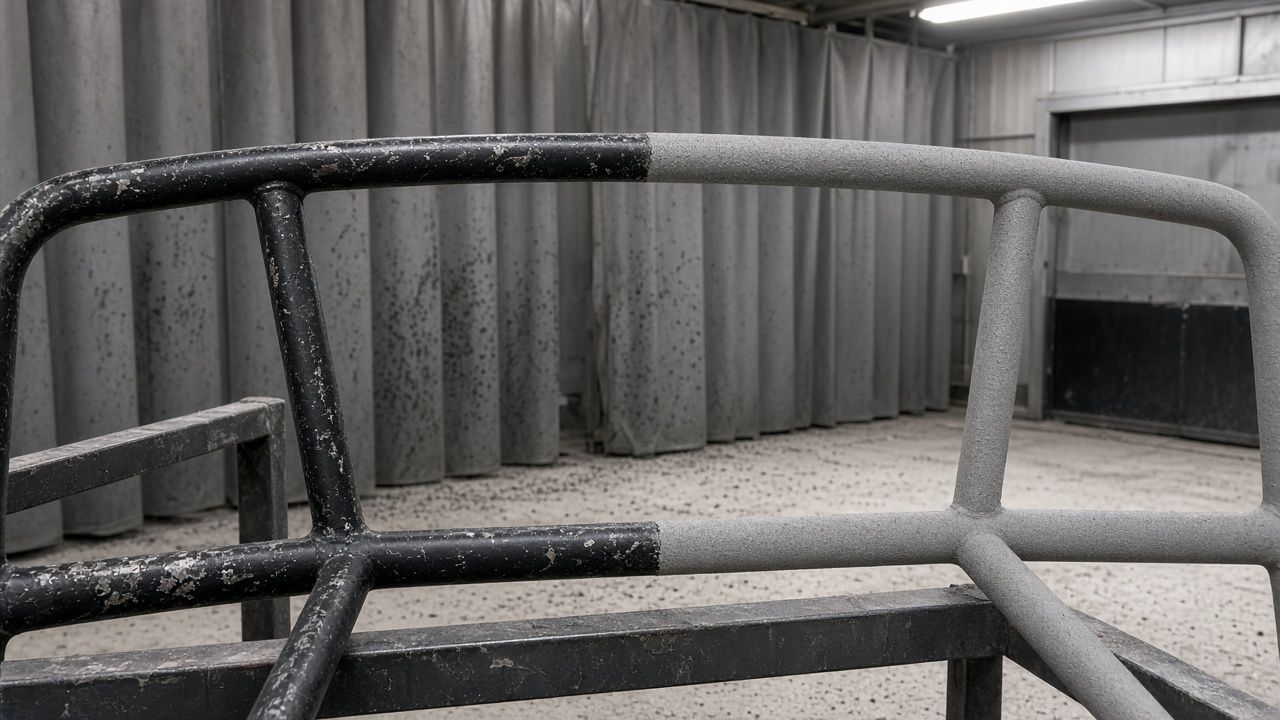
Sandblasting is where the real work begins. It:
- Removes rust, mill scale, and contaminants
- Creates a surface profile for adhesion
- Ensures the coating bonds properly
Without proper blasting, even the best powder will fail.
Typical blasting costs
- Small parts: $25 to $100
- Medium parts: $100 to $300
- Large fabricated pieces: $300 to $1,000+
Media selection
Different media produce different results:
- Aluminum oxide for aggressive cleaning
- Garnet for balanced removal
- Glass bead for lighter finishes
At Full Blown Coatings, this is often where projects are won or lost. A customer might bring in a part that “looks clean,” but once it is blasted, hidden corrosion or contamination becomes visible. That is the difference between a temporary fix and a long-term solution.
Labor and Application Costs
What you are really paying for
Labor includes:
- Cleaning and prep
- Masking critical areas
- Hanging and positioning
- Applying powder evenly
- Managing complex geometries
Why complexity increases cost
Parts with:
- Tight corners
- Weld seams
- Hidden surfaces
- Large flat faces
require more time and skill to coat properly.
Application is not just spraying powder. It is controlled placement to ensure even thickness and full coverage. On high-visibility or specialty projects, custom powder coating expertise often has a direct effect on final quality.
Curing Process and Its Impact on Cost
What happens during curing
Once applied, the powder is heated in an oven where it:
- Melts
- Flows out
- Chemically cross-links into a solid coating
Why curing adds cost
- Large ovens consume significant energy
- Cycle times vary depending on part size
- Large parts require longer heat exposure
For large fabricated structures, curing becomes a major operational cost.
Full Cost Breakdown (Start to Finish)
A typical powder coating project breaks down roughly as:
- Sandblasting: 20–40%
- Labor: 25–35%
- Powder material: 10–20%
- Curing and overhead: 10–20%
The key takeaway is simple:
You are not paying for powder. You are paying for process.

Real Project: Luxury Seamless Stair Systems
Project overview
A client came in with two massive fabricated seamless stair systems for a modern home. These were not standard parts. They were architectural centerpieces.
The finish needed to be:
- Flawless
- Consistent
- Durable
- Long-lasting
The chosen finish was a matte black powder coat.
Challenges
- Large size and heavy weight
- Seamless design meant no room for imperfections
- Highly visible installation
- Required long-term durability
At Full Blown Coatings, projects like this shift the focus from “getting it coated” to “getting it right.”
Prep process
The process began with:
- Full degreasing
- Detailed inspection
- Precision sandblasting
Every inch of the surface had to be uniform. On a seamless structure, any inconsistency will show immediately
after coating.
Application
The matte black powder was applied carefully:
- Even coverage across large surfaces
- Controlled thickness
- Attention to edges and welds
Matte finishes are especially unforgiving. They highlight inconsistencies more than gloss finishes.
Curing
Due to size, the stairs required:
- Large oven capacity
- Even heat distribution
- Controlled cure cycle
This step ensured the coating bonded properly and achieved full durability.
Final result
The finished product:
- Clean, uniform matte black
- No visible defects
- High-end architectural finish
With proper prep and application, this type of coating can realistically last 50+ years in the right environment. For projects like this, pages focused on industrial and commercial powder coating and railings are the most natural next steps for readers exploring architectural or fabricated metal work.
Longevity
With proper prep and application, this type of coating can realistically last 50+ years in the right environment.
Why Powder Coating Lasts So Long
Mechanical and chemical bond
The coating does not just sit on the surface. It bonds through heat and chemistry.
Proper prep equals durability
If the surface is clean and profiled correctly, the coating has a strong foundation.
Even coverage matters
Thin spots fail first. Proper application prevents weak points.
When Powder Coating Is Worth the Cost
Powder coating makes the most sense when:
- The part has long-term value
- It will be exposed to wear or environment
- You want minimal maintenance over time
For high-end fabrication like stairs, railings, or structural elements, it is often the best long-term option.
Common Mistakes to Avoid
- Skipping proper blasting
- Choosing based only on price
- Using low-quality powder
- Poor curing practices
- Treating powder coating like paint
Each of these shortcuts reduces lifespan significantly.
Powder Coating vs Painting Over Time
Upfront cost
Powder coating is usually more expensive initially.
Long-term cost
Painting often requires:
- Recoating
- Maintenance
- Touch-ups
Powder coating reduces these long-term costs.
Final Thoughts
The cost of powder coating is not just a number. It reflects the level of preparation, skill, and process behind the finish.
If you are investing in a project that matters, whether it is architectural metal, automotive parts, or fabrication, the real value comes from doing it correctly the first time.
The luxury stair project is a perfect example. It required more time, more prep, and more precision, but the result is a finish that will hold up for decades.
That is what you are really paying for.
Share This Post!