Powder Coating Near Me | Powder Coating Guide to Line Shops and Batch Shops
TLDR:
- Searching powder coating near me is really about finding the right process, not just the closest zip code. The biggest difference is often whether the shop is built as a batch shop or a line shop. Conveyorized line processing is generally better for repeat, higher-volume work, while batch processing is better for flexible, mixed, or lower-volume work.
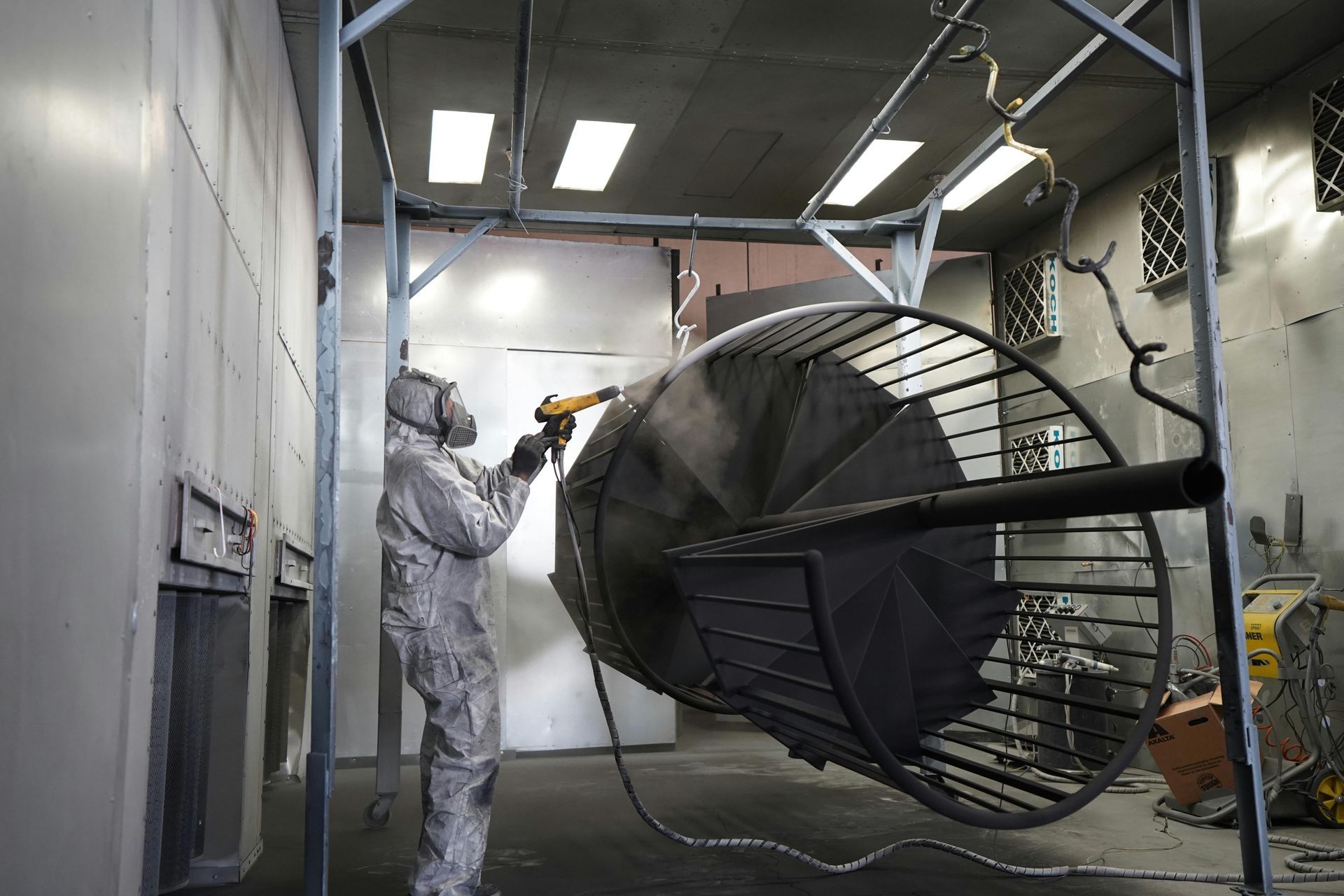
- A powder coating machine is not just a spray gun. In practice it includes the booth, powder feed system, cure oven, racking or conveyor, and the prep process that happens before coating.
- Batch shops are usually the better fit for custom fabrications, restoration work, mixed-part orders, oversized pieces, frequent color changes, and jobs that need more individualized prep.
- Line shops are usually the better fit for recurring production, repeat SKUs, standardized parts, and programs where throughput and consistency matter most.
- No matter which shop type you use, pretreatment and media blasting are critical. TIGER notes that "poor pretreatment can lead to peeling, corrosion, and scrap, and that contamination between the substrate and coating interferes with adhesion".
- Line systems bring their own challenges. TIGER notes that conveyorized applications require control of gun-to-part distance, airflow, line density, and film thickness, so bigger or more automated does not automatically mean “better” for every part.
- If your parts are porous, cast, galvanized, or prone to trapped gases, you also need to think about outgassing, which can cause bubbling, pinholes, adhesion loss, and rework during cure.
Line Shops and Batch Shops: What Are the Use Cases?
When people search powder coating near me, they are often trying to answer the wrong first question. The question usually is not, “Who is closest?” It is, “Who is set up correctly for my job?” That is where the shop’s powder coating machine setup matters. Some shops are built around conveyorized production lines. Others are built around batch-style workflows. Both can produce excellent work, but they serve different kinds of customers, different kinds of parts, and different kinds of schedules.
This distinction matters more than most buyers realize. A small manufacturer with repeatable enclosures may waste time and money using a shop built for one-off custom jobs. A fabricator with mixed weldments, irregular geometry, and changing colors may get frustrated using a line shop built around steady repeat production. The right choice depends on what you are coating, how many parts you have, how consistent those parts are, and how much prep they need before powder is ever sprayed.
At Full Blown Coatings, this is one of the most common disconnects we see with new customers. They often come in thinking every powder coater does basically the same thing. Once we start talking through part counts, geometry, rust, masking, finish expectations, and turnaround, it usually becomes obvious that the type of shop matters almost as much as the coating itself.
What a Powder Coating Machine Really Means
It is a system, not a single tool
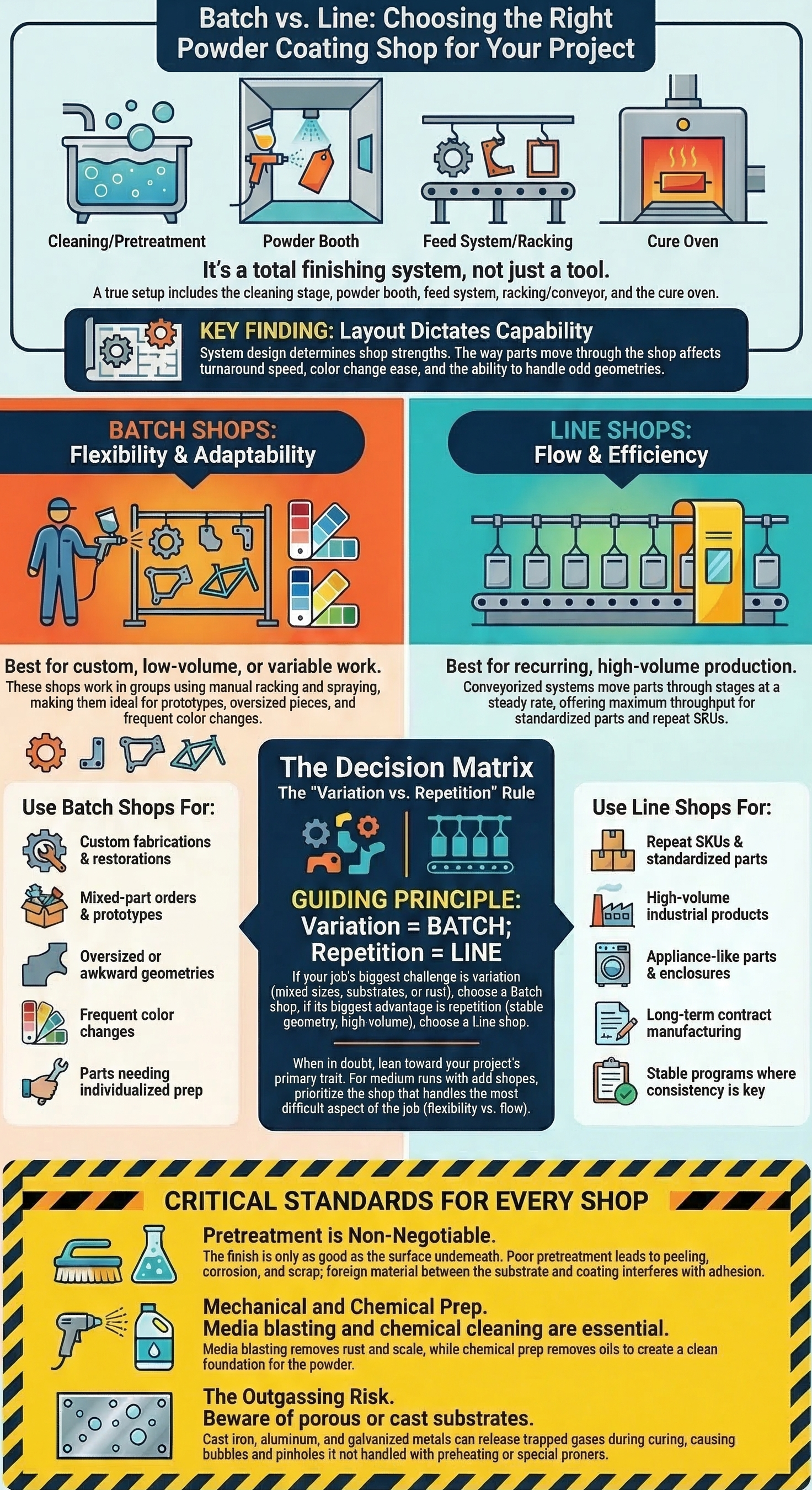
A lot of people hear powder coating machine and think of the spray gun. That is only part of the picture. In real production, the “machine” usually means the whole finishing system: the cleaning and pretreatment stage, the powder booth, the feed or hopper system, the way parts are moved and held, and the cure oven that hardens the finish.
That system layout determines what the shop is naturally good at. Some systems are designed to move lots of similar parts quickly. Others are designed to handle variable work with more manual control. That is why a buyer should think beyond “Do you powder coat?” and ask, “What kind of powder coating operation are you built around?”
Why system design changes the buyer experience
The system affects almost everything:
- how quickly a shop can turn jobs
- how easily it handles color changes
- how well it accommodates odd shapes
- how efficient it is with repeat parts
- how much hands-on attention each part gets
- how much prep flexibility the shop has
That means shop type is not just an internal operational detail. It directly affects cost, quality, and fit.
What Is a Batch Powder Coating Shop?
The simple version
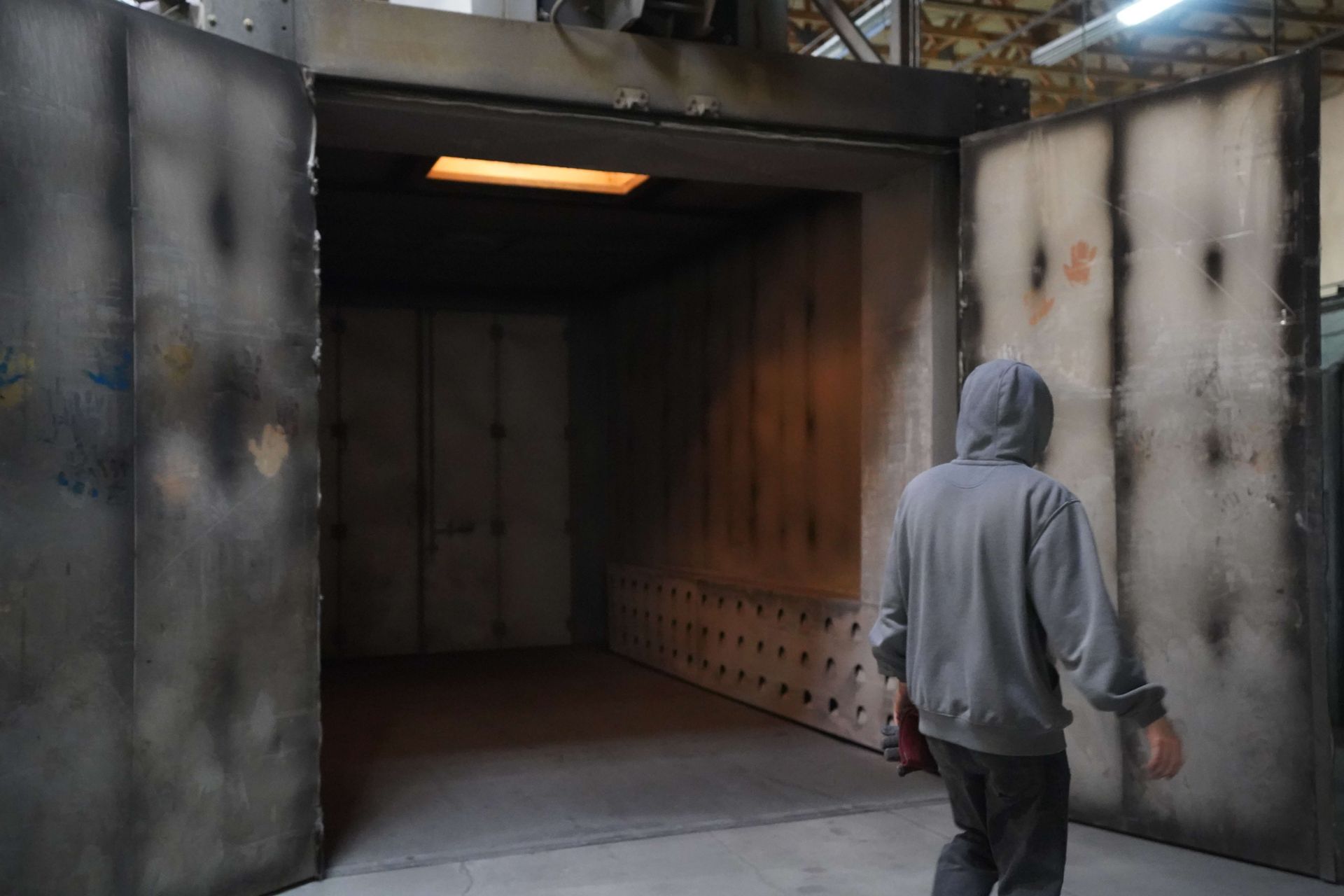
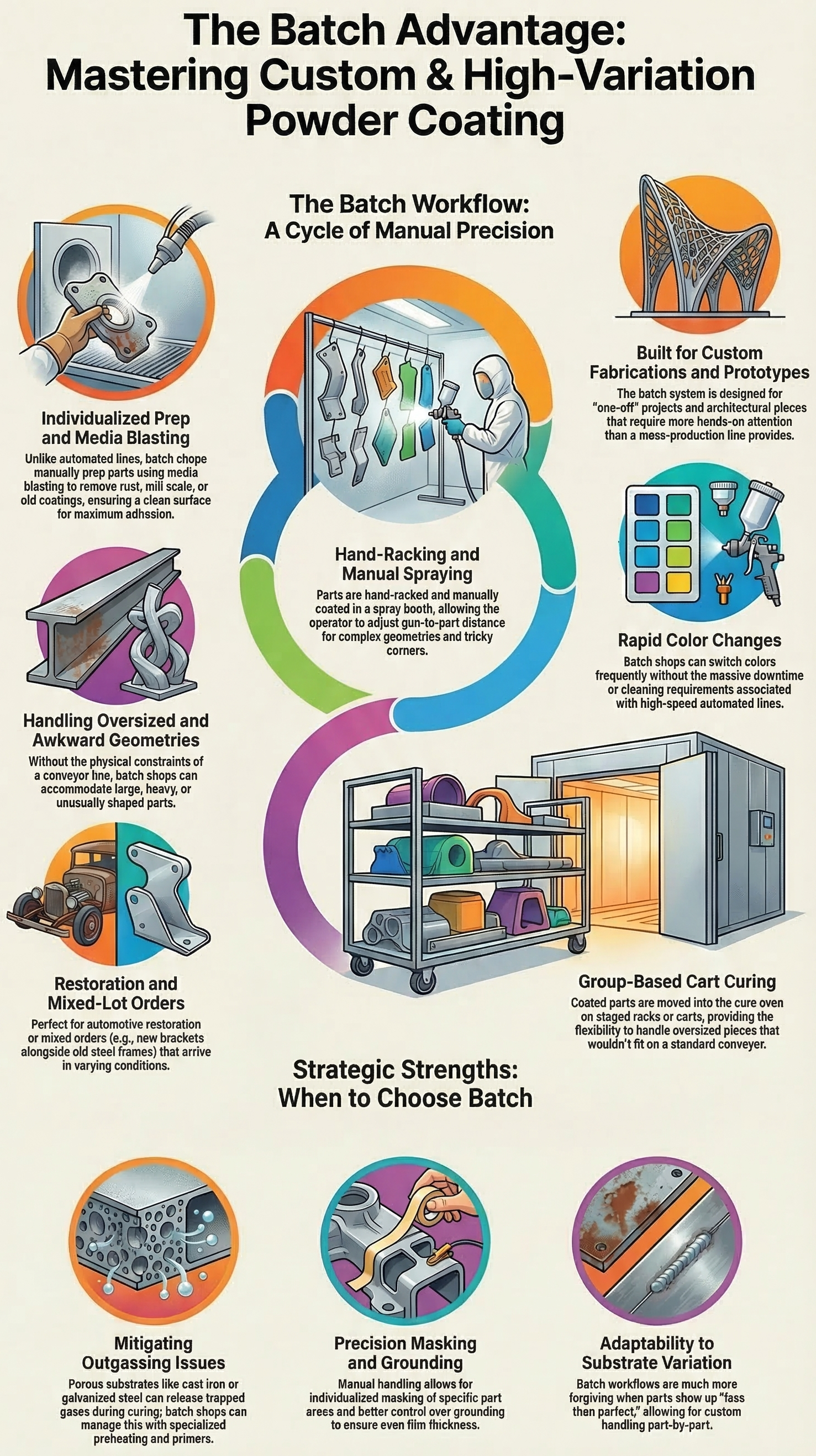
A batch shop works in groups, not in one continuous stream. Parts are typically prepped, coated, and cured in smaller runs. They may be blasted first, hand-racked, manually sprayed, and then moved into an oven in carts or staged racks rather than traveling automatically through a full conveyorized line. This style is commonly associated with small- to medium-sized batch operations and more manual control.
Where batch shops usually shine
Batch shops are usually the better choice for:
- custom fabricated parts
- low-quantity orders
- restoration work
- prototypes
- mixed lots
- oversized pieces
- unusual or awkward geometries
- projects with frequent color changes
- jobs where incoming part condition varies a lot
This is where batch shops earn their keep. They are often much more forgiving when real-world parts show up less than perfect.
A good example is a local fabrication customer bringing in a mixed order: some new brackets, a few old steel pieces with surface rust, a welded frame with tricky corners, and several parts that need masking in different places. On paper, that may look like one powder coating order. In reality, it is a high-variation job. A batch workflow is usually much better suited to that kind of work because it allows more custom handling and more individualized prep.
Why custom work often belongs in batch
Batch shops tend to make more sense when no two jobs look exactly the same. If you are doing custom metal fabrication, off-road parts, restoration, architectural one-offs, or prototype runs, the flexibility is usually worth more than raw throughput.
That is also where shop experience matters. A skilled batch operation often knows how to adjust for part shape, orientation, grounding, masking, and visual requirements part by part. That is very different from optimizing a line for thousands of nearly identical units.
What Is a Line Powder Coating Shop?
The simple version
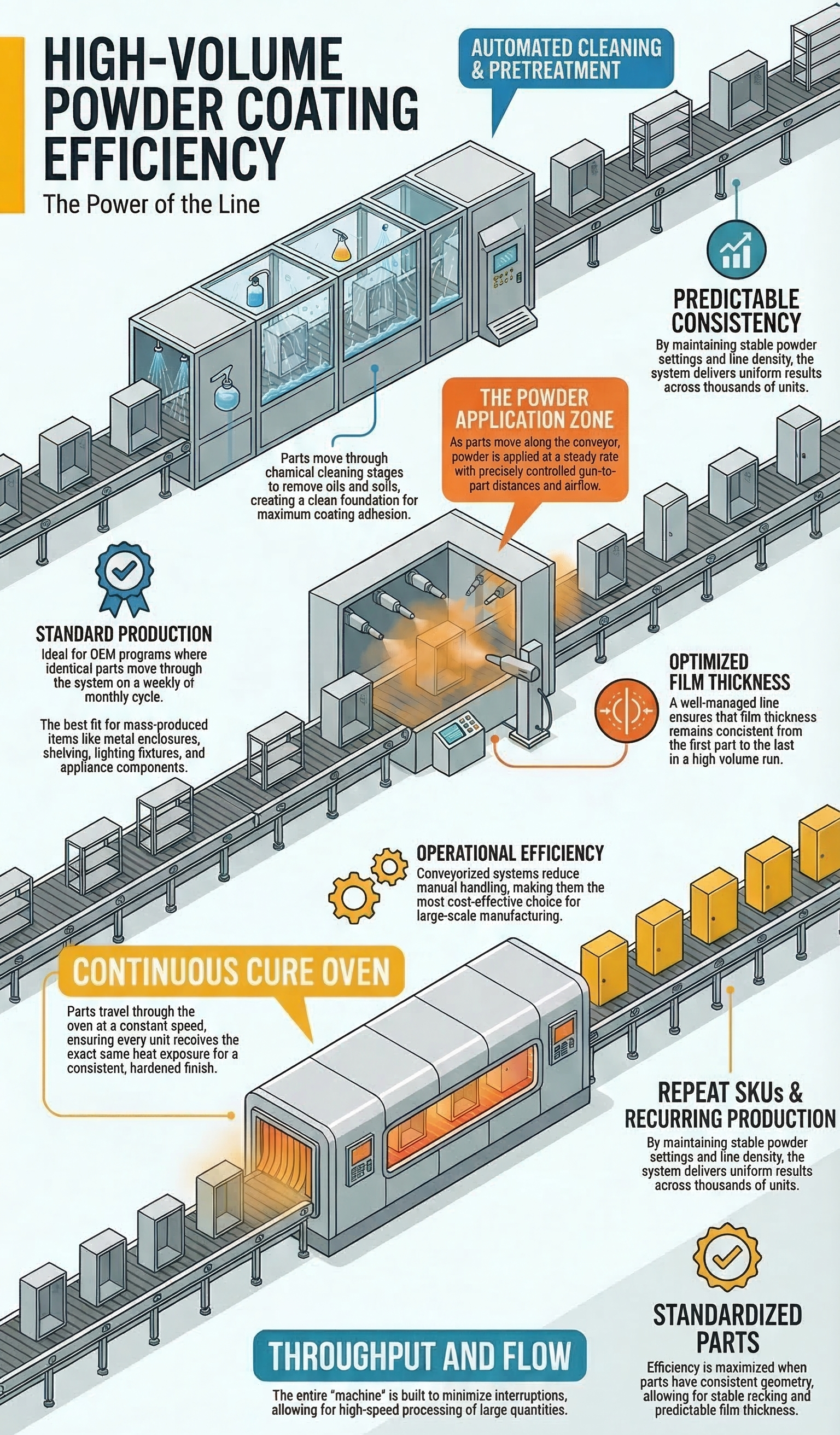
A line shop uses a conveyorized system to move parts through finishing stages at a steady rate. Depending on the setup, parts may move through cleaning, pretreatment, dry-off, powder application, and curing with much less interruption and much more repetition than a batch shop. Conveyor processing is built around flow and is typically the better match for higher volumes.
Where line shops usually shine
Line shops are usually the better choice for:
- repeat SKUs
- recurring production work
- standardized enclosures
- shelving and fixtures
- lighting components
- appliance-like parts
- high-volume industrial products
- OEM or contract manufacturing programs
If the parts are similar, the finish requirements are stable, and the volume is high enough, line shops can be extremely efficient. This is where repeatability and throughput really start to matter.
Why line shops are attractive for production buyers
For a manufacturer running the same part over and over, a line shop can be ideal. The more stable the job, the more that conveyorized process can pay off. Consistent hang points, consistent part spacing, stable powder settings, and predictable oven time all work in your favor when the parts themselves are repeatable.
This is the kind of setup that works well for national product lines, contract production, and multi-run programs where every week or month the same parts come back through.
Line Shops vs Batch Shops: Which One Fits Your Job?
If your job is custom, choose flexibility
If your job involves:
- one-offs
- mixed sizes
- varied substrates
- heavy rust or old coatings
- masking differences
- frequent color changes
- irregular shapes
then a batch shop is usually the more natural fit.
You are paying for adaptability. That is often the right trade.
If your job is repetitive, choose flow
If your job involves:
- repeat orders
- stable part geometry
- consistent volume
- limited color changes
- predictable racking
- production-level timelines
then a line shop may be the better fit.
You are paying for efficiency and process stability. That is often the right trade.
If your job is “in between”
A lot of real work falls in the middle. Maybe you have a medium-sized run, but the parts are odd-shaped. Maybe you have repeat parts, but you need frequent color changes. Maybe the quantity is decent, but the condition of incoming parts is inconsistent.
That is where a quick buyer rule helps:
- If the job’s biggest challenge is variation, lean batch.
- If the job’s biggest advantage is repetition, lean line.
That is not a perfect rule, but it is a useful one.
Why Pretreatment and Media Blasting Matter in Both
The finish is only as good as the surface underneath
One of the biggest buyer mistakes is assuming the powder itself determines the whole result. It does not. TIGER is very direct that cutting corners in pretreatment can lead to peeling, corrosion, and scrap, and that foreign material between the substrate and coating interferes with adhesion.
That means prep is not a side detail. It is part of the finish system.
Mechanical prep vs chemical prep
TIGER distinguishes between mechanical pretreatment, such as abrasive blasting, and chemical pretreatment, such as cleaning chemistries. Many real-world jobs need one or both depending on contamination, substrate, and required performance.
In practical terms:
- Media blasting is often essential for rust, mill scale, failed coatings, and rough field-used parts.
- Chemical prep is often key for oils, soils, and creating a cleaner foundation for adhesion.
- Better shops know when a job needs both.
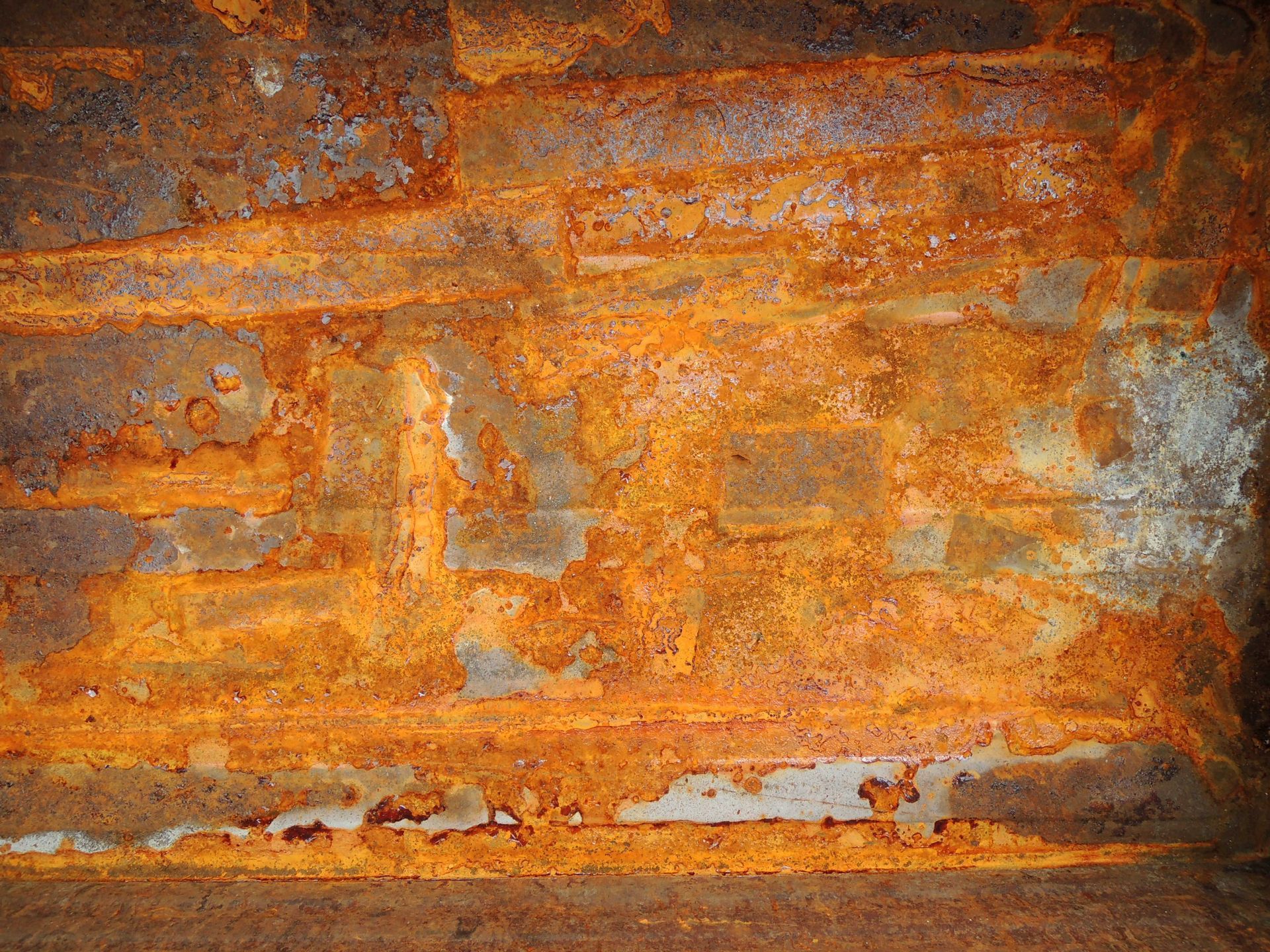
A common shop example is an old steel frame that looks “mostly fine” to the customer but still has rust tucked into corners, oil at handling points, and failed coating in seams. That part may not need a miracle powder. It needs serious prep first.
Why this changes shop choice
Batch shops often pair well with blast-heavy custom work because they can slow down and handle variation. Line shops can absolutely include sophisticated prep, but they are generally happiest when incoming parts are more standardized and the process can stay stable.
The Hidden Challenges of Line Shops
Bigger systems create their own problems
A lot of buyers assume line shops are always better because they are bigger or more automated. Not necessarily. TIGER notes that conveyorized applications bring specific process variables such as gun-to-part distance, airflow, line density, and film-thickness variation. In horizontal lines, maintaining proper gun distance matters. In vertical lines, gravity can affect film thickness from top to bottom.
That means a line can be incredibly effective, but only if it is well-managed and the parts are a good match for the system.
Consistency is earned, not automatic
A good line produces consistency because it is dialed in, not because it exists. If part spacing is off, grounding is poor, airflow is wrong, or line density changes too much, results can suffer. Buyers with large production work should ask real process questions, not just admire the conveyor.
Outgassing: The Problem Many Buyers Never Hear About
Why some parts bubble or pinhole
TIGER explains that porous substrates such as iron, steel, and aluminum can release trapped gases during curing, which can lead to bubbling, pinholes, and loss of adhesion. TIGER also notes that cast metals and some galvanized substrates can be especially vulnerable.
Why this matters when choosing a shop
If your parts are cast, porous, galvanized, or known to be troublesome, the shop needs to know that before coating starts. This is not just a materials issue. It is a process issue. Some jobs need preheating, special primers, or extra process attention to avoid rework.
This is exactly the kind of thing that separates a shop that “coats parts” from a shop that actually understands finishing.
Questions to Ask Before Choosing a Powder Coating Shop Near You
Do not stop at price and turnaround. Ask:
- Is this job a better fit for your batch setup or your line setup?
- Do you offer media blasting?
- What pretreatment steps are included?
- How do you handle odd geometry or masking?
- How often do you run color changes?
- Have you coated this type of substrate before?
- Is outgassing a risk on these parts?
- How do you manage film thickness and cure consistency?
These questions will tell you more than a gallery page ever will.
Final Thoughts
The phrase powder coating near me sounds simple, but the right shop choice is usually a process decision. A powder coating machine setup tells you a lot about what a shop is built to do. Batch shops usually win on flexibility, customization, and mixed work. Line shops usually win on scale, repeatability, and production flow. Both can do excellent work. The smart move is to match the shop to the job.
At Full Blown Coatings, the most successful projects are usually the ones where this conversation happens early. Once the shop understands the real use case, part condition, volume, and finish expectations, the path gets a lot clearer. That is when the coating process stops being a commodity and starts becoming a real solution.
Share This Post!