The Technicalities of Sand Blasting: The Exact Settings and Media for Every Project
TL;DR
- There is no single correct PSI, grit, or blasting medium for every project. The right setup depends on the substrate, thickness, coating being removed, target surface profile, nozzle, abrasive, and final finish.
- Is higher PSI better? Not necessarily. Higher pressure can remove coatings faster, but it can also create excessive profile, damage aluminum, warp thin metal, wear equipment faster, and waste abrasive.
- What is the best blasting media? Aluminum oxide and garnet are strong choices for aggressive coating and rust removal. Glass bead is better for gentle cleaning and satin finishing. Soda, walnut shell, and plastic media are useful when protecting delicate substrates matters more than fast cutting.
- What should you use before powder coating? The goal is a clean, stable surface with the correct anchor profile for the powder system. That may require angular abrasive, but the exact media and settings depend on the part.
- Can sand blasting damage metal? Yes. Incorrect media, excessive pressure, poor nozzle distance, or too much dwell time can distort thin sheet metal, roughen aluminum, remove galvanizing, or damage precision surfaces.
- Professional blasting is about achieving a measurable surface condition, not simply turning the machine up until the coating disappears.
The technicalities of Sand Blasting become much more important once you move beyond the idea that every project can be handled with the same abrasive and the same pressure setting. Steel, aluminum, stainless steel, galvanized metal, castings, wheels, railings, and automotive panels all respond differently to abrasive impact.
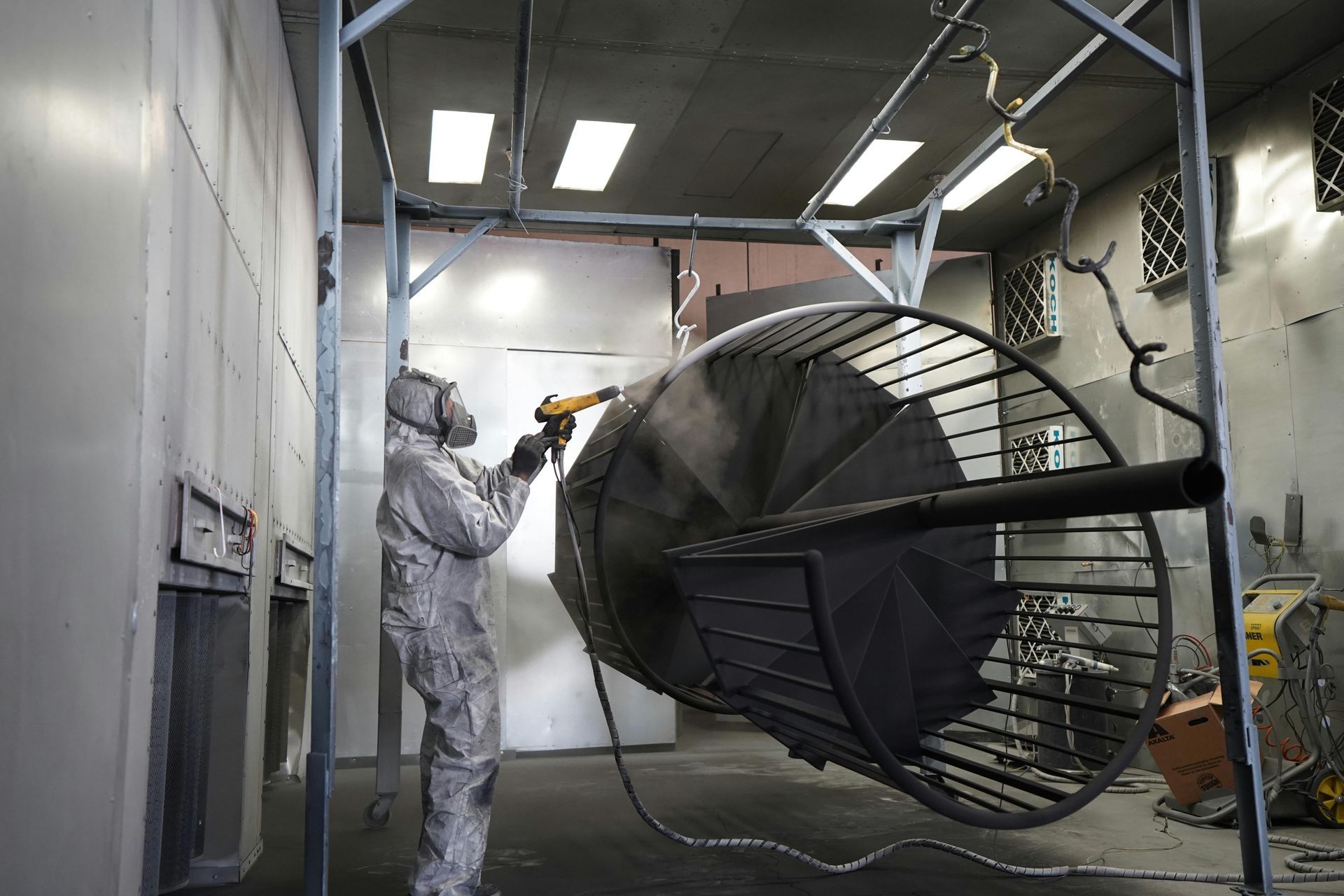
Before a part reaches powder coating, Full Blown Coatings evaluates the substrate, existing finish, and intended result to determine the appropriate media blasting process. That decision can affect adhesion, appearance, corrosion resistance, and whether the part survives blasting without damage.
One of the best summaries of professional surface preparation comes from AMPP: “Never paint a dirty surface.”
Simple statement, complicated execution.
There Is No Universal Sand Blasting Setting
One of the most common questions you will see online is something like:
“What PSI should I sandblast aluminum at?”
The problem is that PSI alone does not tell you enough.
Imagine two aluminum parts. One is a thick cast wheel covered in failed powder coating. The other is a thin decorative panel with light paint. Both are aluminum, but using the exact same abrasive, pressure, angle, and dwell time on both could produce very different results.
Professional blasting starts with the outcome you need.
You need to know what you are removing, how much material the substrate can tolerate losing, how smooth the final surface needs to be, and what coating will be applied afterward.
The Main Variables That Control Blasting
Media Type
Abrasive shape and hardness determine how the particles interact with the surface.
Angular media such as aluminum oxide and garnet cut into coatings and metal. That makes them useful for stripping rust, powder coating, mill scale, and industrial paint while creating an anchor profile.
Rounded media such as glass bead behaves differently. Instead of cutting as aggressively, the particles tend to clean and peen the surface. This can leave aluminum or stainless steel with a smoother satin appearance.
That distinction is why asking for "sandblasting" without discussing the media is incomplete.
Grit Size
Coarser abrasive generally cuts faster and creates a deeper profile. Finer abrasive generally provides more control and produces a shallower texture.
That does not mean coarse is better for tough jobs in every situation.
If you are preparing a highly visible railing for a smooth gloss powder, an excessively deep profile may remain visible beneath the final coating. You might remove the old finish quickly but create another finishing problem.
Pressure
Increasing air pressure increases particle velocity.
That can improve production speed, but it also increases impact energy. On heavy structural steel, that may be useful. On thin aluminum, the same aggressive approach may create unnecessary roughness or distortion.
In powder-coating forums, aluminum is one of the most common sources of problems. Operators report getting acceptable results on steel with a setup that leaves aluminum rough, pitted, or visibly uneven.
That is why an experienced blaster adjusts the process to the substrate rather than treating the pressure gauge as the specification.
Nozzle Distance and Angle
Move the nozzle closer and you concentrate the blast. Move farther away and the blast pattern spreads.
Angle matters too. A direct impact tends to profile aggressively, while a shallower angle can help strip a coating with less direct impact into the substrate.
The operator is constantly balancing removal rate against surface damage.
Dwell Time
Even a reasonable blasting setup can become too aggressive if you remain in one spot too long.
This is especially important with thin sheet metal. Excessive localized blasting can generate enough impact and heat to distort the panel.
A skilled operator keeps moving.

Why CFM Matters Just as Much as PSI
Another common forum question is why a blast cabinet barely moves media even though the regulator shows plenty of pressure.
The answer is often airflow.
PSI tells you pressure. CFM tells you how much air the compressor can continuously deliver.
Your nozzle consumes a significant amount of air. If the compressor cannot keep up, the initial blast may feel strong and then weaken as tank pressure falls.
Nozzle size, hose diameter, hose length, compressor output, moisture control, and pressure all interact.
Full Blown Coatings addresses this in its guide to compressor sizing for sandblasting. A professional system is designed around continuous airflow, not just the maximum PSI printed on the compressor.
Aluminum Oxide: Fast Cutting and Strong Profiling
Aluminum oxide is one of the most useful abrasives when you need substantial cutting action.
It is hard, angular, and capable of removing durable powder coating, rust, paint, and oxidation. It can also create the profile needed for a new coating.
Full Blown Coatings used aluminum oxide on industrial brackets from a Salt Lake City manufacturer that needed durable exterior coatings. In that case, creating a strong coating-ready profile was an advantage.
That same approach would not automatically be appropriate for a thin aluminum panel.
The strength of aluminum oxide is also its limitation. If you do not control grit, pressure, distance, and dwell time, it can produce a surface that is much rougher than necessary.
Garnet: Strong General-Purpose Cutting
Garnet is another angular abrasive that works well for rust, paint, and heavy coating removal.
It is commonly used on fabricated steel, machinery, trailers, structural components, and industrial equipment.
Full Blown Coatings has used garnet on vintage farm equipment from Farmington where decades of rust needed to be removed without destroying the underlying steel.
That type of project is a good example of why media selection is about more than aggressiveness. You need enough cutting power to remove the corrosion efficiently while still preserving the component.
Glass Bead: Cleaning Without Excessive Cutting
Glass bead is generally a better fit when you want to clean and refine rather than aggressively strip and profile.
It can work particularly well on aluminum and stainless steel where a smooth, satin surface is desirable.
Full Blown Coatings used glass bead on an aluminum motorcycle frame for a Logan customer who wanted a uniform, non-glossy surface before finishing.
That is a completely different objective from removing heavy rust from structural steel.
Glass bead may be the better media for one and a frustratingly slow choice for the other.
What About Soda, Plastic, and Walnut Shell?
Softer abrasives become valuable when protecting the substrate is more important than creating an aggressive anchor profile.
Soda blasting can remove some coatings while leaving relatively little profile. Plastic media can be useful on thin automotive components, composites, and sensitive parts. Walnut shell can clean certain delicate surfaces without the cutting action of aluminum oxide.
The tradeoff is that a surface stripped with very soft media may still require another preparation step before powder coating.
Removing the paint and preparing the metal for a new finish are not always the same job.
Steel and Aluminum Should Not Be Blasted the Same Way
Steel can generally tolerate more aggressive surface preparation than aluminum.
A thick steel trailer frame with heavy corrosion may benefit from an angular abrasive and a substantial profile. You want to remove the rust, eliminate the failed coating, and create a stable foundation for the next coating system.
Aluminum requires more restraint.
Aluminum wheels, signs, trim, and fabricated parts can be etched too deeply or visually damaged when the media is excessively aggressive.
One recent powder-coating forum discussion involved aluminum signs that developed an uneven texture even after the operator reduced blasting pressure substantially. The same setup was causing no issue on steel. That illustrates the point perfectly: pressure was only on variable. The softer substrate and abrasive interaction changed the result.
Thin Automotive Panels Require Their Own Strategy
Thin body panels are where brute-force blasting becomes especially risky.
If the blasting process puts too much impact or heat into a panel, you can produce waves, stretching, or oil-canning. Once that happens, removing the coating is no longer your biggest problem.
A professional approach may involve softer media, lower impact energy, greater nozzle distance, shallower angles, faster travel, and short passes.
There is no responsible universal statement such as “blast every automotive panel at 60 PSI.”
The correct setting is the one that removes the coating without moving the metal.
Stainless Steel Brings Contamination Concerns
Stainless steel adds another technical consideration: contamination.
If carbon-steel particles become embedded in stainless, those particles can corrode and create rust staining on a surface that was selected specifically for corrosion resistance.
Clean glass bead or another suitable nonferrous abrasive may be used depending on the required finish.
Dedicated media and clean equipment can matter when contamination control is important.
Again, the media is selected based on the result.
Galvanized Steel Needs a Lighter Touch
Galvanized steel has a protective zinc layer.
If you aggressively blast it like bare structural steel, you can remove the very coating that provides corrosion protection.
Certain coating systems call for a controlled sweep or brush blast. The objective is to clean and lightly profile the zinc without stripping it away.
This is one of the clearest examples of why "cleaner" does not always mean "better."
What Surface Profile Are You Trying to Create?
Professional blasting is not judged only by whether you can see bare metal.
AMPP surface-preparation standards distinguish between cleanliness and surface profile. A surface may look clean while being too smooth for the specified coating. Another surface may be rough enough but still contaminated.
Surface profile is the microscopic pattern of peaks and valleys created by blasting.
The coating needs enough texture to develop proper mechanical adhesion, but excessive profile can create its own problems.
If the peaks are too tall for the coating thickness, they can receive insufficient coverage. A very aggressive profile can also show through smooth decorative powders and increase coating consumption.
For industrial work, profile may be measured using comparator plates, replica tape, or profile gauges rather than judged by eye alone.
What Do SP-5, SP-10, and SP-6 Mean?
AMPP standards give contractors a defined end condition instead of simply saying "blast it clean."
SP-5 White Metal Blast Cleaning is an extremely thorough blast-cleaning condition where visible contamination is removed.
SP-10 Near-White Metal Blast Cleaning permits only very limited staining and is widely associated with high-performance protective coating work.
SP-6 Commercial Blast Cleaning permits more staining while still requiring removal of visible contamination and loose material.
There are also brush-off and industrial blast-cleaning standards for less aggressive preparation.
These standards matter because a project specification may require a particular cleanliness level regardless of what the surface looks like to an untrained eye.
What Media Is Best Before Powder Coating?
There is no single best abrasive.
For heavy steel coating removal, aluminum oxide or garnet may be ideal.
For aluminum, fine crushed glass, carefully controlled aluminum oxide, or another suitable abrasive may make more sense depending on the part.
For stainless cosmetic finishing, clean glass bead may be appropriate.
What matters most is what the surface looks like after blasting.
Before powder coating, you generally want a clean, stable substrate with an appropriate anchor profile, no residual dust or abrasive, no oils, and no unstable corrosion.
The blasting process should also anticipate the final powder appearance. A smooth metallic or gloss finish will reveal substrate texture differently than a heavy wrinkle or textured powder.
How Long Can Blasted Metal Sit Before Coating?
This is another question that comes up constantly in forums.
There is no universal safe waiting period because humidity, temperature, salts, substrate, and storage conditions all matter.
Freshly blasted carbon steel is highly reactive. In humid conditions, flash rust can develop surprisingly quickly.
Professional shops try to control the time between blasting and coating and avoid unnecessary handling or exposure.
This is one advantage of having blasting and powder coating performed in the same facility. The prepared part does not need to travel between different contractors while the bare surface is exposed.
Can Sand Blasting Damage Metal?
Absolutely.
Poorly controlled blasting can cause:
- Warping
- Excessive surface roughness
- Pitting
- Removed galvanizing
- Damaged threads
- Rounded details
- Altered machined surfaces
- Embedded media
- Cross-contamination
The answer is not to avoid blasting. The answer is to match the blasting process to the project.
The Better Question to Ask Your Blasting Shop
Instead of asking:
“What PSI do you use?”
Ask:
“What media and surface profile are you targeting for my substrate and final coating?”
That question tells you much more about the shop.
A capable blasting company should be able to explain why it selected the abrasive, what it is trying to remove, how it will protect critical surfaces, and what condition the part needs to be in before coating.
Final Thoughts
Understanding the technicalities of Sand Blasting means recognizing that professional abrasive blasting is a controlled surface-preparation process, not a pressure contest.
The correct combination of media, grit, airflow, pressure, nozzle, distance, angle, and dwell time changes with the substrate and the coating system that comes next.
A heavy steel frame may need aggressive cutting. An aluminum wheel needs more control. A thin body panel demands restraint. Stainless requires contamination awareness. Galvanized steel may only need a light profile.
That is why there is no honest universal chart that can tell you the exact pressure for every project.
The professional goal is simpler:
Use the least aggressive process that efficiently achieves the required cleanliness and surface profile without damaging the substrate.
When blasting is approached that way, it becomes more than a method for removing old paint. It becomes the foundation for a powder coating or metal-finishing system that has a much better chance of looking right and lasting.
Share This Post!