Powder coating for park homes: durability, prep, finishes, and costs
Powder coating for park homes: durability, prep, finishes, and costs
If you are evaluating Powder coating for park homes for railings, stairs, awnings, gates, skirting frames, or outdoor furniture. This guide explains why powder coating outperforms paint for long-term outdoor use. It is written for homeowners, park managers, and HOAs across Salt Lake County, Utah County, Davis County, Weber County, and Cache County who are searching for powder coating near me, media blasting, and durable metal finishing that stands up to Utah’s sun, wind, and winter deicers.
Why powder coating fits park homes
Powder coating is an electrostatic application of dry resin that melts and chemically cures in an oven, forming a dense, uniform film. Compared to wet paint, it delivers thicker edge coverage, better chip resistance, superior gloss retention, and stronger corrosion protection—when the prep and pretreatment are done correctly.
Full Blown Coatings: An HOA in Sandy brought us porch railings that had been brush-painted every other year. The finish kept chalking in the sun and peeling near welds. We stripped, media blasted, iron-phosphated, and recoated in a super-durable polyester satin black. Three winters later the rails still present a deep, even sheen with no peeling at the welds, and the HOA has not had to budget for annual repainting.
Ideal applications around park homes
- Safety and access: handrails, guardrails, stair stringers, ramp rails, grab bars
- Shade and shelter: awning frames, pergolas, carports, porch structures
- Perimeter and privacy: fencing, gates, privacy screens, mailbox clusters
- Utility and protection: skirting frames, HVAC cages, meter guards, bike racks
- Lifestyle and decor: patio sets, benches, planters, light poles, signage frames
These parts typically live outdoors year-round and benefit most from a robust coating stack and disciplined surface preparation.
The process that determines service life
Surface inspection and disassembly
Parts are checked for cracks, corrosion depth, and hardware issues. Removable hardware is taken off to ensure complete coverage and a clean cure.
Chemical strip and degrease
Legacy coatings, oils, and contaminants are removed. Coating over unknown paint is a recipe for future failure.
Media blasting to bright metal
Blasting creates a clean, uniform anchor profile so the coating keys into the surface. Aluminum oxide or crushed glass is common for steel components; glass bead or milder media can be used to refine aluminum without distortion.
Conversion coating
A phosphate or zirconium conversion layer increases adhesion and improves corrosion resistance. This step is the difference between a finish that looks good in month one and a system that still protects in year five.
Special considerations by substrate
- Cast aluminum: pre-bake to outgas and prevent pinholes, especially on smooth light colors.
- Galvanized steel: lightly profile without removing protective zinc; then use compatible chemistries.
- Previously powder-coated parts: full strip and re-prep avoids compatibility surprises.
- Stainless: passivation or thorough cleaning ensures proper adhesion.
Application, cure, and verification
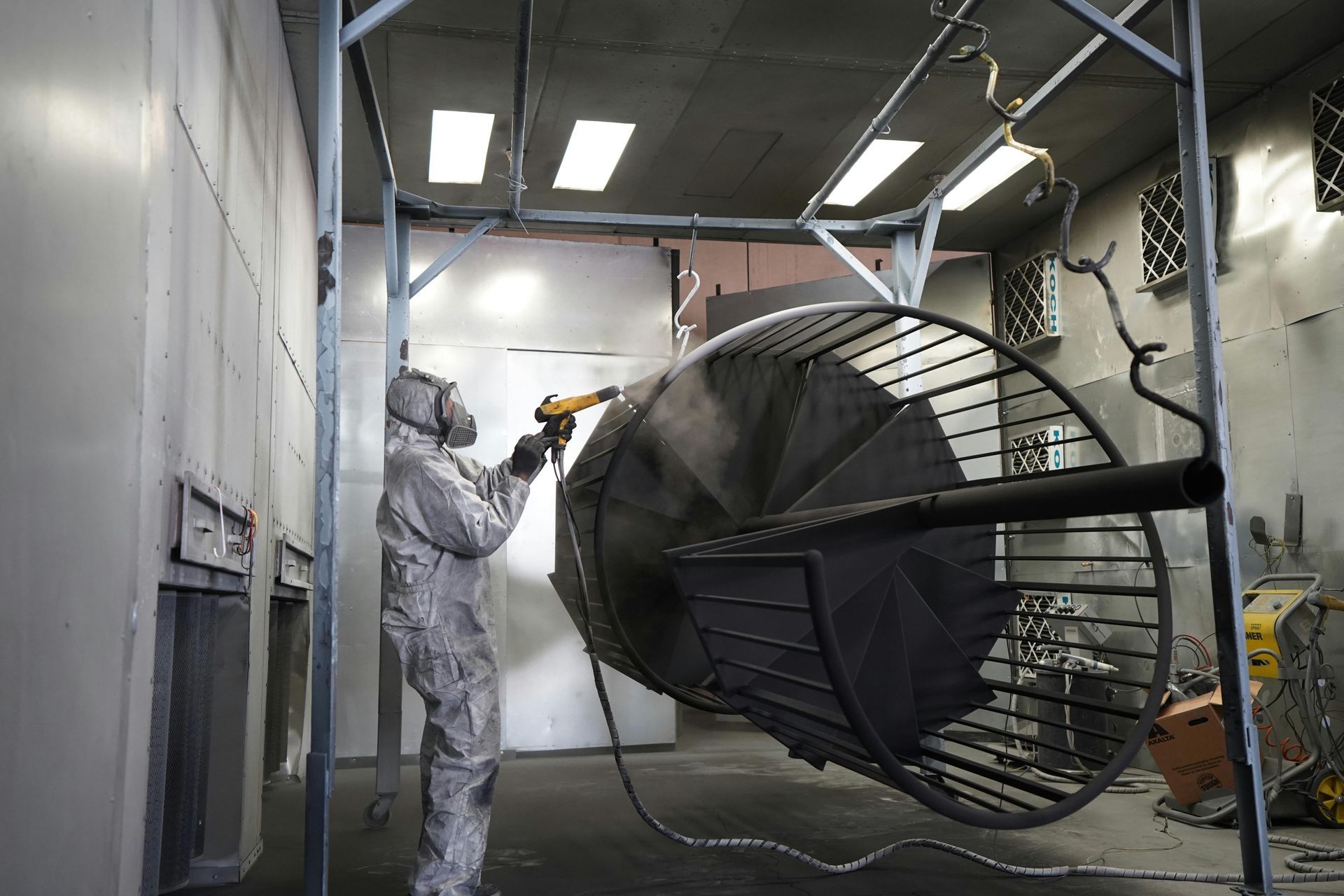
Powder is applied with a calibrated gun, then cured in an oven to the manufacturer’s time and temperature spec. Cure is verified at part temperature with probes or verified profiles, and film thickness is measured with a calibrated DFT gauge. Critical interfaces—hinge bores, threads, grounding points—are masked for fit and safety.
Full Blown Coatings: We coated a set of galvanized privacy panels in Park City where high UV and wind-blown grit had punished prior paint. By adjusting blast media, using a zinc-friendly pretreatment, and specifying a super-durable polyester in a low-gloss texture, the panels now hide scuffs and clean easily with a hose.
Choosing the right exterior chemistry and sheen
Super-durable polyester
For Utah altitude sun, super-durable polyester is the workhorse. It maintains color and gloss better than standard polyester and is a strong match for architectural installations.
Gloss, satin, or matte
- Gloss: deep color and easy washing; shows scratches more readily.
- Satin: modern appearance with good cleanability; hides minor marks.
- Matte/fine-texture: best at hiding fingerprints and scuffs; choose carefully if frequent hand contact or abrasive cleaners are expected.
Clear coats and specialty options
A clear topcoat adds depth and improves stain resistance on light colors, whites, and metallics. Anti-graffiti and antimicrobial options exist for high-touch or public-facing assets.
Full Blown Coatings: A community in North Ogden selected a fine-texture bronze for handrails. The texture hid small grinder marks at welds and resisted handprints on sunny days, cutting down on routine cleaning calls.
Color planning for park communities
Palette strategy
- Neutrals that blend with stone and stucco: satin black, graphite, charcoal, bronze, sable.
- Accents for wayfinding or brand: seafoam green, forest green, deep navy, champagne.
- Consistency across phases: lock in vendor and code references; save control chips for future orders.
Samples and mockups
Screens are unreliable. Review physical chips outdoors at different times of day, or request small test panels. On long corridors or large gates, consider how sheen and texture influence perceived straightness and weld appearance.
Performance in Utah conditions
Utah’s combination of high UV, freeze–thaw cycles, mag chloride, and wind-blown grit is demanding.
- UV and heat: exterior-grade super-durable chemistries and clear coats hold color and gloss.
- Deicers and moisture: a primer on steel plus correct film build and edge coverage helps prevent undercut rust.
- Design details: add drain paths, deburr sharp edges, and radius corners to reduce early film failure.
- Fasteners and dissimilar metals: choose compatible hardware or isolation washers to reduce galvanic corrosion.
Full Blown Coatings: We replaced peeling paint on lake-adjacent railings in Utah County with a primer plus color system and a slightly rounded edge prep. The HOA reported no blistering at miters after winter, a first in many years.
Cost drivers and realistic ranges
Every project is unique, but the same inputs drive cost and schedule:
What affects price
- Condition of existing parts: rust depth, paint removal, weld cleanup
- Part geometry and count: more surfaces and tight corners mean more time
- Coating stack: single color versus primer plus color or color plus clear
- Masking complexity: hinges, latches, threads, and multi-piece assemblies
- Special-order powders versus in-stock inventory
- Logistics: pickup and delivery, crating for large assemblies
Typical ranges to frame expectations
- Handrails: often priced by linear foot based on profile and weld count
- Small gates and panels: per piece, with adders for texture or clear
- Patio chairs and tables: per piece or per set depending on strip/blast effort
- Awnings and pergolas: by project after site photos and material specs
Request a line-item quote that separates prep, coating, clear, and logistics. This makes future maintenance and add-on work straightforward.
Installation and retrofit best practices
- Batch scheduling: grouping similar pieces reduces per-unit cost and color variation.
- Protection: pad coated surfaces during transport and installation; avoid metal-on-metal contact.
- Hardware: use coated or stainless fasteners compatible with the substrate and finish.
- Field touch-ups: keep a matched touch-up kit for tiny nicks during install; for larger damage, contact the shop before attempting repairs.
Full Blown Coatings: A Weber County park home community staged rail sections by building block, which let us blast and coat in consistent lots. The result was uniform color and sheen throughout, and the HOA benefited from volume pricing.
Maintenance and care plan
- Washing cadence: rinse quarterly or after storms with pH-neutral soap and soft brushes.
- Avoid harsh chemicals: strong acids and aggressive degreasers can haze satin and matte.
- Seasonal inspection: check weld toes, edges, fasteners, and ground contact points.
- Preventive steps: add plastic caps where metal meets concrete to reduce wicking corrosion.
- Recoat timing: if damage exposes bare metal, address promptly to avoid undercut rust.
Frequently asked questions
Can powder coat go over galvanized steel or anodized aluminum?
Yes, with compatible profiling and pretreatment. The process differs from bare steel or mill-finish aluminum.
Will textured finishes trap dirt?
Fine textures resist fingerprints and hide marks; routine rinsing keeps them clean. For heavy dust zones, a smoother satin may be easier to wash.
How long will the finish last outdoors in Utah?
With proper prep, pretreatment, super-durable chemistry, and routine washing, many architectural applications see service lives measured in multiple seasons before cosmetic refresh is considered.
Can you match existing community colors?
Exact paint parity is rare. We coordinate visually with physical chips in sunlight and document the chosen vendor and code for future phases.
Do you remove and reinstall parts?
Most shops can coordinate logistics. Ask for a pickup and delivery option and request guidance for protecting parts during install.
Local service and next steps
A successful project combines disciplined prep, compatible chemistries, and realistic logistics. If you manage or own property in Salt Lake County, Utah County, Davis County, Weber County, or Cache County, and you want outdoor metal that looks good and stays that way, we recommend starting with site photos and a brief scope. Review physical chips outdoors, confirm the coating stack, and make sure cure and film-thickness checks are part of the process.
Full Blown Coatings can help with evaluation, color sampling, and a line-item quote that bundles blasting, pretreatment, coating, clear, and transport. Recent park-home projects include railings and privacy panels in Park City, porch sets in North Ogden, and mailbox clusters in Murray. If you would like the same level of quality and documentation, contact Full Blown Coatings to schedule a color consult and receive a detailed proposal.
Share This Post!