3 Key Differences between Paint and Powder Coating

admin • January 2, 2018

Powder coating applicationsIf you’re looking to finish and seal a material, you usually look for paint to help you do the job. However, for rugged materials that need to be hardy and long-lasting, you should always look into powder coatings first.

It’s true that there are many paint options that are tough and long-lasting. And there are other advantages and disadvantages that might make it difficult to decide exactly which coating is best for you. Here are some of the most important distinctions between paint and powder coating to help you make your decision:

Solvents

If you remember nothing else, this is the most important thing to know about paint versus powder coating. Paint requires a solvent in order to help it transform from liquid form (for application) to a solid form (after it dries, to ensure that it creates an effective coat.) Different solvents are used for different paints, but the truth is that most of the time, they’re harsh chemicals that aren’t great to have in your home. Solvents are the reason that we get headaches from the smell of drying paint.

Unlike paint, powdered coating material never becomes a liquid. It’s applied in powdered form, which means it never needs a solvent to transform it from liquid to solid. It just stays solid the whole time.

Eco Considerations

Because powder coatings are solvent-free, they are often used for things that require eco-conscious considerations under changes of temperature and use. For example, it can be dangerous to use certain kinds of paints on children’s toys or cribs, or perhaps on dog fences or cages, because you never know if a child or pet is going to munch on the material, or ingest chips that fall.

Powder coatings are used on industrial materials that require intense heating, as well as household products you probably use every day. For example, the internal coating of microwaves is almost always powder coating because it needs to endure extreme temperatures regularly without compromising the integrity of the coating, or the safety of edible materials.

Bonded Material

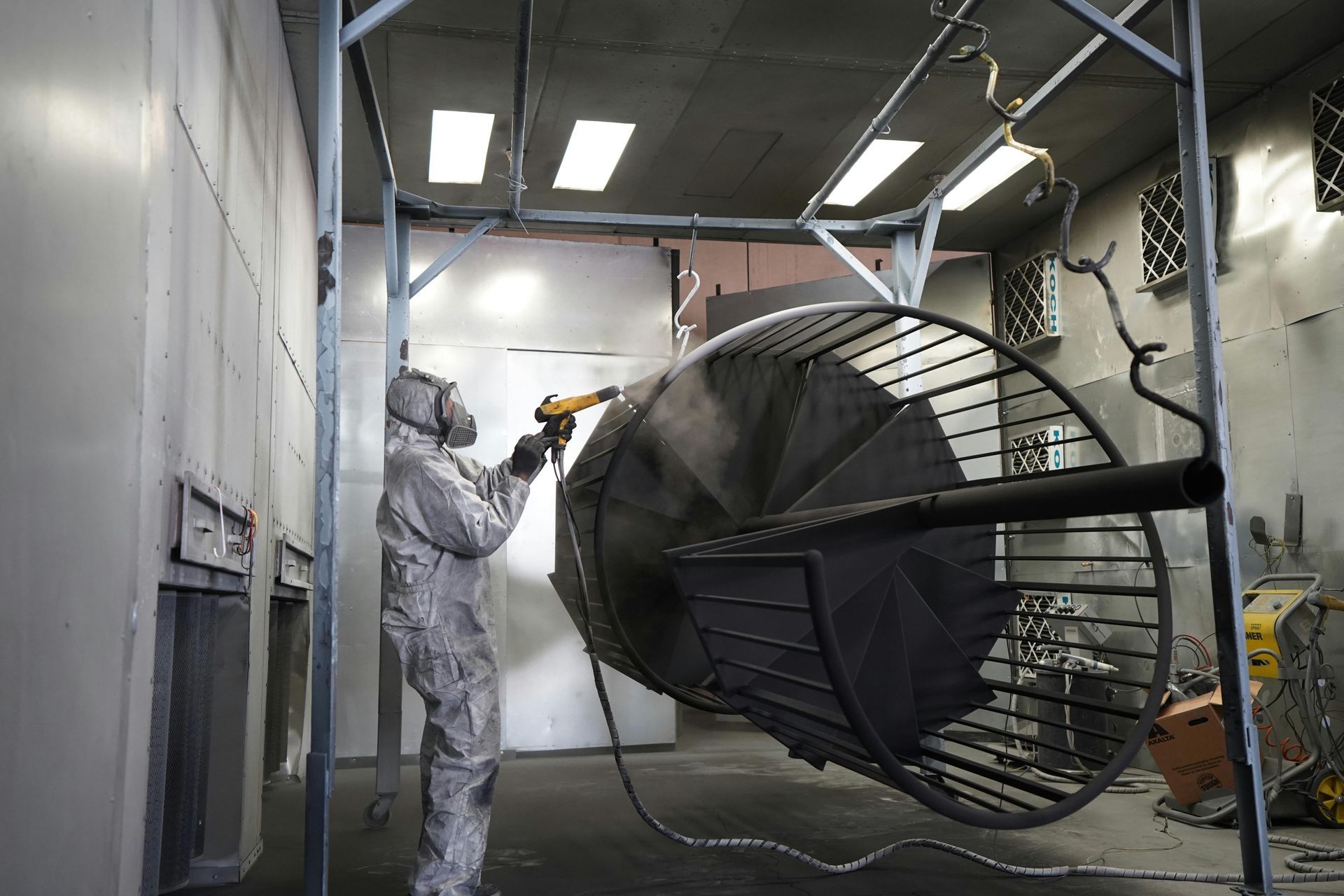
Again, because powdered coatings are applied in solid form, you have a perfectly-fitted coat that doesn’t chip away from the original material. In fact, powder coatings coat in a way very different from paint. Rather than simply covering a material, powdered coatings are bonded to the material, electrostatically applied and set in so that the coating will last just as long as the material itself.

Powder coating being bonded to the material also allows for a very welcome attribute: powder coatings are able to move with the material, holding up while the material expands and contracts instead of becoming strained and cracked through fluctuations of temperature. Powder coatings are the best option for things that need to be flexible and frequently used, like springs.

Share This Post!

Yellow caution sign showing a worker digging on a road at night with cones and tape in the background
By Admin August 3, 2026
Learn what a Sand Blaster does, how blasting equipment works, required skills, safety training, certifications, and career paths in metal finishing.
Blue suspension arm and shock absorber under a vehicle in a garage, viewed from below
By Admin July 30, 2026
Explore the latest powder coating technology advances, including low-temperature curing, recycled materials, stronger corrosion protection, and smarter application.
Silver Mercedes sedan parked on a wet street at dusk with an orange bus in the background
By Admin July 23, 2026
Learn what chrome powder coat is, its best uses, how it compares to real chrome, and when clear coating polished metal may be the better choice.
Close-up of clear plastic sleeves on a brown cardboard surface with a metal rail and mounting holes
By Admin July 14, 2026
Meta Description: Learn what aluminum oxide media blasting is, its benefits and common uses, and how it removes rust and coatings before powder coating.
Close-up of a yellow alloy wheel rim with black bolts and silver metal trim
By Admin July 11, 2026
TL;DR: How long does powder coating rims take? A standard set of four rims commonly takes about three to seven business days. The powder application and oven cure are fast. Stripping, media blasting, repairs, cooling, tire service, and scheduling create most of the turnaround. Tires, valve stems, wheel weights, and center caps generally need to be removed. Bent rims, cracks, curb rash, corrosion, custom colors, and multi-stage finishes can add time. Same-day service is possible in limited cases when the shop is equipped and the wheels need little or no repair.
Close-up of a black surface with scattered white paint chips beside a white sheet of paper
By Admin July 9, 2026
TL;DR: Wrought iron paint is usually a liquid-applied coating system designed to protect metal and improve appearance, often with brush, roller, or spray application. Powder coat is usually better for durability when the part can be properly removed, blasted, coated, and cured in a professional setup. Paint is usually easier to apply and easier to touch up , especially for on-site repairs, fixed railings, gates, and older metal that is hard to remove. Powder coating is usually the better choice for new or removable metalwork when you want a more uniform, harder, longer-lasting finish. The real answer depends on the project. If the metal is large, highly visible, or too important to risk, powder coating usually makes more sense than trying to paint or coat it casually. For most staircases, gates, and railings, the biggest difference is not just paint vs powder. It is the prep, blasting, and cure behind the finish. Wrought Iron Paint vs Powder Coat: Which Finish Makes More Sense for Your Metal Project? If you are comparing wrought iron paint vs powder coat , you are really comparing two very different finish systems. Both can make metal look cleaner and more finished. Both can protect the surface. But they do not go on the same way, they do not age the same way, and they do not make sense for the same kinds of projects. If you want to understand the bigger process behind powder coating before choosing, it helps to look at How Powder Coating Works , Media Blasting , and Industrial and Commercial Powder Coating first. Those pages give a clearer picture of what actually separates a durable finish from one that just looks decent on day one. A useful expert quote from Full Blown Coatings says it simply: “Powder coating isn’t just about looks, it’s about performance.” That matters in this comparison because a lot of people choose a finish based on color or convenience first, then only later realize that maintenance, prep, and durability were the real decision. What Wrought Iron Paint Usually Means When most people say wrought iron paint , they usually mean a liquid-applied coating system designed for metal railings, gates, fences, staircases, and decorative ironwork. It might be brushed on, rolled on, or sprayed on. In many cases, it is chosen because it is familiar, easier to buy locally, easier to touch up, and easier to apply on site. That last point matters. Paint is often the more practical option when: the part is already installed the metal cannot be removed easily the owner wants a repairable finish the project needs a faster field-applied solution There is nothing wrong with wrought iron paint when it is chosen for the right reason. The problem is that people sometimes expect paint to perform like powder coat without giving it the prep or maintenance that would help it get there. What Powder Coat Usually Means Powder coating is a different process altogether. Instead of brushing or spraying a liquid coating onto the metal and letting it dry, powder coating uses a dry powder that is electrostatically applied to a grounded metal part and then cured under heat. That cure process turns the powder into the final protective film. That means powder coating is usually best suited for parts that can be: removed from the site cleaned thoroughly blasted or otherwise prepped correctly coated in a controlled environment cured in an oven large enough for the part When all of those conditions are met, powder coating usually produces a finish that is thicker, harder, and more uniform than conventional paint.
Rows of small cups filled with brightly colored powder in blue, pink, purple, yellow, and green
By Admin June 26, 2026
Learn how to powder coat at home, what equipment and prep it really takes, and why most staircases, gates, and large metal projects are better left to a professional powder coating shop.
Abstract close-up of a metallic spiral tunnel with gray and blue reflections
By Admin June 10, 2026
Learn whether the type of metal matters when powder coating and how steel, aluminum, stainless, and galvanized metal affect prep, adhesion, cost, and long-term finish performance.
Industrial interior with towering metal stairs, pipes, and catwalks in a dimly lit factory
By Admin June 2, 2026
Learn where industrial powder coating is commonly used, from equipment housings and factory piping to railings, fixtures, and commercial metalwork, and why blasting and prep matter so much.
Close-up of cracked turquoise painted surface with dark fissures and a thin border line
By Admin May 26, 2026
Learn when powder coating needs to be redone, the warning signs of cracking and peeling, what causes finish failure, and how proper blasting and recoating restore metal protection.